
Constipation Relief at Home: Gentle Methods That Actually Work
The most effective change you can make for constipation relief at home takes about ten seconds to set up and costs less than a takeaway. It is not a supplement, a tea or a cleanse. It is a small footstool in front of the toilet — and almost nobody tries it, because it is far less interesting than the list of remedies you were expecting.
That is roughly the shape of this whole subject. A few unglamorous things work reliably, several popular remedies work modestly, one or two can make matters worse, and a small number of symptoms mean you should stop reading articles and book an appointment. This guide sorts them honestly, grades the evidence rather than listing everything as equally “natural and effective”, and includes the gentle yoga and breathing work that suits this problem particularly well.
Quick answer
For constipation relief at home, drink more fluid, move for 15–20 minutes, and use a footstool so your knees sit above your hips on the toilet. Two kiwifruit or a portion of prunes daily helps within days, and a gentle abdominal massage can ease a stubborn episode. See a GP if constipation lasts more than three weeks, or sooner if you notice bleeding or unexplained weight loss.
Why trust this guide
- Every remedy below is labelled by how strong the evidence behind it actually is, rather than presented as equally proven.
- Safety guidance follows NHS advice for adults in the UK, including the symptoms that need a GP rather than a home remedy.
- Where a popular remedy has weak evidence or a real drawback, we say so instead of padding the list.
- This is general education, not medical advice, and it does not replace care from your GP, pharmacist or specialist.
- Written and reviewed by the Spiritual Meditation Yoga Editorial Team. Last reviewed: September 2026.
Key takeaways
- There is no “correct” number of bowel movements. What matters is a change from your own normal.
- Toilet position is the most underused fix available, and it costs almost nothing.
- Fibre works — but increased too quickly, or without extra fluid, it makes bloating and discomfort worse.
- Kiwifruit, prunes and psyllium all help; kiwifruit tends to cause the least bloating.
- Common medicines, including some painkillers and iron tablets, are a frequent and overlooked cause.
- Gentle twists, knees-to-chest positions and slow belly breathing support the gut without strain.
- Bleeding, unexplained weight loss, or a persistent change in habit after 50 needs a GP appointment, not a remedy.
Table of contents
- What counts as constipation?
- Fastest things to try today
- Toilet posture: the change most people never try
- Food and drink, graded by evidence
- How to increase fibre without making things worse
- Abdominal massage, step by step
- Gentle yoga and breathing for the bowel
- Medicines that commonly cause constipation
- Laxatives explained — and the dependency question
- Constipation in pregnancy and after birth
- When to see a GP: red flags
- Real case study: kiwifruit, prunes or psyllium?
- Common mistakes
- Editor’s insights
- What to try first, by situation
- A seven-day gut-friendly reset
- Frequently asked questions
- About the author
What counts as constipation?
Constipation means a change in how you pass stool — going less often than is normal for you, or finding it hard, painful or incomplete. The usual clinical marker is fewer than three bowel movements a week, but frequency alone is a poor test. Some people go three times a day and some go every other day, and both can be perfectly healthy.
The NHS describes constipation as common at every age, and notes that it can usually be treated at home with changes to diet and lifestyle. Alongside infrequency you may notice straining, hard or lumpy stools, a feeling that you have not finished, stomach ache, bloating or nausea.
One group deserves a specific mention. If you are caring for an older person, or someone with dementia or a learning disability, constipation is easily missed and may show up as confusion, agitation or a change in behaviour rather than a complaint. Discomfort that cannot be described still needs to be looked for.
Fastest things to try today
If you want relief now rather than a long-term plan, work through this list in order:
- Drink a large glass of water or a warm drink. Warmth and fluid together encourage the gut to get moving, and hydration is what allows fibre to do its job at all.
- Move for 15–20 minutes. A brisk walk is enough. Movement stimulates the natural contractions that push stool along.
- Use a footstool on the toilet so your knees are higher than your hips, and lean forwards with your forearms on your thighs.
- Go after a meal. Eating triggers a reflex that increases bowel activity, which is why the urge is often strongest 20–40 minutes after breakfast.
- Do not strain or sit for long stretches. If nothing happens in about ten minutes, get up and try again later. Straining risks haemorrhoids and anal fissures, which then make the next attempt worse.
- Try gentle abdominal massage (see the step-by-step below), ideally 30–60 minutes after eating.
- Consider a pharmacy laxative if a few days have passed. A pharmacist can tell you which type suits your situation.
Toilet posture: the change most people never try
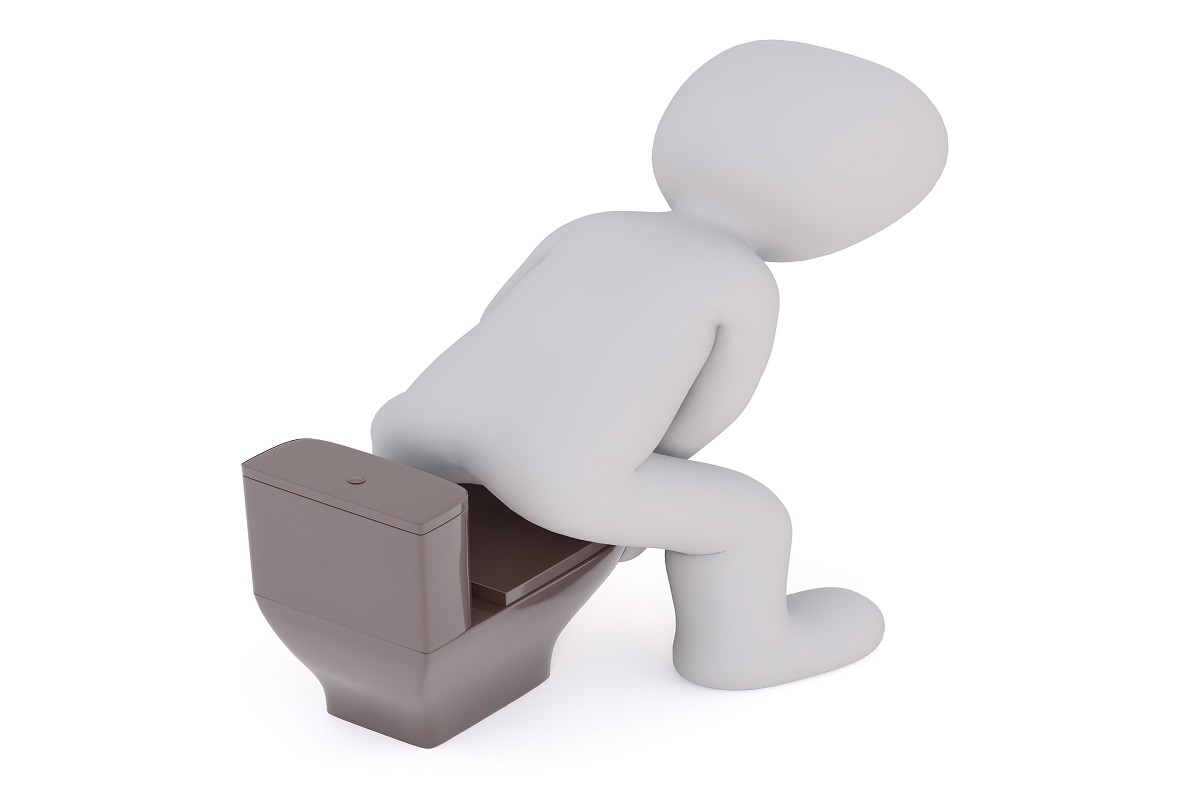
Sitting upright on a standard toilet keeps a muscular sling around the lower bowel partly engaged, which maintains a bend in the passage — useful for staying continent during the day, less useful when you are trying to empty. Bringing the knees above the hips relaxes that sling and straightens the route, so less effort is needed.
How to sit
- Place a low footstool, a step, or a stack of books in front of the toilet — roughly 15–20cm high.
- Sit with both feet flat on it so your knees sit clearly above your hips.
- Lean forwards from the hips and rest your forearms on your thighs. Keep your back long rather than hunched.
- Let your belly relax and bulge outwards. Most people pull the stomach in, which works against you.
- Breathe out slowly through the mouth rather than holding your breath and bearing down.
- Give it a few minutes without forcing. If nothing comes, stand up and return later.
Evidence note: the research here is small in scale, mostly measuring straining, sitting time and how complete emptying feels. That is modest evidence — but the change is free, carries no risk, and many people notice a difference the same day, which makes it a sensible first step rather than a last resort.
Food and drink, graded by evidence
Most guides list a dozen foods as though they were interchangeable. They are not. Here they are sorted by how much human evidence sits behind them, so you can spend your effort where it is most likely to pay off.
Strong evidence
Psyllium (ispaghula husk). A soluble fibre supplement, well studied and widely used. It bulks and softens stool. Start low and always take it with plenty of water. Bloating and wind are the usual complaints.
Prunes (dried plums). Repeatedly shown in trials to increase stool frequency and soften consistency, typically at around 100g a day. They combine fibre with sorbitol, a sugar alcohol that draws water into the bowel.
Kiwifruit. Two green kiwifruit a day has been tested in several trials, including head-to-head against prunes and psyllium, with comparable benefit and notably fewer side effects.
Moderate evidence
Dietary fibre generally. Fruit, vegetables, wholegrains, pulses. Effective over weeks rather than hours, and the increase has to be gradual — see the next section.
Fluid. Hydration on its own rarely fixes constipation in someone already well hydrated, but fibre without adequate fluid reliably makes things worse. Treat it as a requirement, not a remedy.
Physical activity. Regular movement supports normal transit. Helpful and worth doing; not a rescue plan for today.
Coffee. Stimulates bowel activity in many people within minutes. Bear in mind it is also mildly diuretic, so pair it with water rather than replacing water with it.
Early or mixed evidence
Probiotics. Some studies report improved stool frequency, but strains and doses vary so widely that results are hard to generalise. Speak to a doctor first if you are immunocompromised.
High-mineral (magnesium-rich) water. Tested in a handful of small trials with some benefit. Low risk for most people.
Flaxseed and other seeds. Plausible and commonly recommended; trial evidence is thinner than for psyllium.
Traditional use — take care
Senna tea. Genuinely a stimulant laxative, not a gentle herbal drink. Suitable for short-term use only, and it can cause cramping. It is not a daily wellness habit.
Castor oil. An old remedy with a strong stimulant effect and unpleasant cramping. Not recommended in pregnancy, and not something to reach for routinely.
Herbal blends containing senna or similar. Some can interact with prescribed medicines. Check with a pharmacist before combining anything with existing prescriptions.
How to increase fibre without making things worse
This is where most home attempts fail. Someone reads that fibre helps, doubles their intake overnight, and within two days feels bloated, gassy and more blocked than before. They conclude fibre does not work for them. In fact they changed too much, too fast, with too little fluid.
Three rules make the difference:
- Increase gradually. Add roughly one extra portion every few days and let your gut adjust. Reaching a good intake over a month beats reaching it by Thursday.
- Add fluid at the same time. Soluble fibre works by holding water. Without it, you have added bulk without softness — exactly the wrong result.
- Use both types. Soluble fibre (oats, psyllium, apples, pulses) softens and gels; insoluble fibre (wholegrains, bran, vegetable skins) adds bulk and speeds transit. Most people who struggle have plenty of one and little of the other.
Editor’s insight: If fibre has made you feel worse in the past, you have useful information, not a verdict. Halve the amount, double the water, and add it over a fortnight instead of a weekend.
Abdominal massage, step by step
Abdominal massage is used in clinical settings for long-standing constipation. It follows the path of the large bowel, which travels up the right side of the abdomen, across beneath the ribs, and down the left.
- Timing. Roughly 30–60 minutes after a meal, when bowel activity naturally increases.
- Position. Lie on your back with knees bent and feet flat, or sit reclined. Let the abdomen soften.
- Start low right. Using flat fingers or a loose fist, make small circles just inside the right hip bone.
- Travel the route. Work slowly up the right side, across under the ribs, then down the left side to the left hip.
- Pressure. Firm but comfortable. This should never be painful.
- Duration. Five to ten minutes, breathing slowly throughout. Repeat daily rather than intensely.
Who should not do this: avoid abdominal massage in pregnancy, after recent abdominal surgery, with an abdominal hernia, active inflammatory bowel disease, undiagnosed abdominal pain, or any abdominal lump — and ask a healthcare professional first if you are unsure.
Gentle yoga and breathing for the bowel
Two things make yoga a sensible companion here. It provides gentle movement and mild abdominal compression without strain, and the slow breathing that accompanies it shifts the body towards the resting state in which digestion works best. Digestion is not a priority for a nervous system braced for a difficult day — and stress-related constipation is extremely common.
A short morning sequence, five to ten minutes, before your first drink of the day:
- Knees to chest (apanasana). On your back, draw both knees towards the chest and hold gently for 5–8 slow breaths. Release and repeat twice.
- Gentle supine twist. Knees bent and together, lower them slowly to one side, arms wide, head turning the other way. Hold for 6 breaths each side.
- Wind-relieving pose (pawanmuktasana). One knee at a time to the chest, the other leg long, 5 breaths each side.
- Supported squat (malasana). Feet apart, sitting bones towards the floor, heels supported by a folded blanket if they lift. Stay for 30–60 seconds, breathing into the belly.
- Seated forward fold, unforced. Bend the knees generously and rest the chest towards the thighs for 6 breaths.
Then finish seated or lying with slow diaphragmatic breathing: one hand on the belly, breathe in for a count of four so the hand rises, out for six as it falls. Two or three minutes is plenty. The exhale is the part that matters — a longer out-breath is what encourages the shift towards rest.
Evidence note: research on yoga specifically for constipation is early — small studies, short follow-up, and often bundled with other lifestyle changes. Treat it as a well-tolerated support with a plausible mechanism, not a proven treatment. Safety: skip deep twists and strong abdominal compression in pregnancy, after recent abdominal surgery, with a hernia, or with any back condition your clinician has warned you about. Nothing here should hurt.
Medicines that commonly cause constipation
If your constipation started or worsened within a few weeks of a new prescription, the cause may be sitting in your medicine cabinet rather than on your plate. Medicines frequently associated with constipation include opioid painkillers such as codeine and morphine, iron tablets, some antidepressants, certain blood pressure medicines, antacids containing aluminium or calcium, and some medicines used for bladder or allergy symptoms.
Important: never stop or change a prescribed medicine because of constipation. Speak to your GP or pharmacist — there is often a different formulation, a dose adjustment, or a laxative routinely prescribed alongside it. Opioid-related constipation in particular usually needs a specific plan rather than more fibre.
Laxatives explained — and the dependency question
| Type | How it works | Typical timing | Notes |
|---|---|---|---|
| Bulk-forming | Adds fibre bulk and holds water | 2–3 days | Must be taken with plenty of fluid |
| Osmotic | Draws water into the bowel | 2–3 days | Commonly used for longer-term management |
| Stimulant | Prompts the bowel muscles to contract | 6–12 hours | Faster, but cramping and loose stools are common |
| Stool softener | Lets water mix into the stool | Varies | Often used where straining must be avoided |
Are laxatives addictive? Short-term use of the right type, as directed, is a normal part of treating constipation and is not something to feel anxious about. The concern applies mainly to prolonged, unsupervised use of stimulant laxatives. If you find yourself needing a stimulant laxative regularly for more than a week or two, that is the signal to see a GP — not to keep going quietly, and not to stop everything abruptly.
Constipation in pregnancy and after birth
Constipation is common during pregnancy and in the weeks after giving birth, and the usual first steps still apply: fluid, gradual fibre, gentle movement and good toilet position.
What changes is caution. Avoid castor oil, avoid senna and other stimulant laxatives unless a midwife, GP or pharmacist has specifically advised them, and skip deep abdominal massage and strong twists. Iron supplements prescribed in pregnancy are a frequent contributor, so mention constipation at your next appointment rather than working around it alone.
When to see a GP: red flags
Book an appointment if:
- Constipation has lasted more than three weeks despite diet and lifestyle changes
- There is blood in your stool, or bleeding from the bottom
- You are losing weight without trying
- You feel unusually tired, or have been told you are anaemic
- You have a persistent change in bowel habit, particularly if you are over 50
- You have severe or persistent abdominal pain, or you are vomiting
- You cannot pass wind at all, or the abdomen is swollen and painful — seek urgent advice
- A baby, young child or an older person in your care is affected and simple measures are not helping
None of these means something serious is happening. They mean the question is no longer one a home remedy can answer. In the UK you can also speak to a pharmacist without an appointment, or call NHS 111 if you are unsure how urgent something is.
Real case study: kiwifruit, prunes or psyllium?
The study. Researchers at a US medical centre compared three natural treatments in adults with chronic constipation, published in the American Journal of Gastroenterology in 2021. Seventy-nine patients were partially randomised to two green kiwifruit a day, 100g of prunes a day, or 12g of psyllium a day for four weeks, with complete data for 75.
What it found. All three increased the number of complete spontaneous bowel movements. Stool consistency improved with kiwifruit and prunes, and straining improved with all three. The kiwifruit group also reported significantly less bloating, had the fewest side effects, and were the least likely to be dissatisfied with their treatment.
What it means for you. If you have tried fibre supplements and abandoned them because of bloating, kiwifruit is a reasonable next thing to try — same job, gentler ride.
Limitations, honestly. The study was small and exploratory, only partially randomised, had no placebo group, and the participants were predominantly female at a single centre. One analysis also noted that the kiwifruit benefit appeared to ease after the first fortnight. Encouraging, not conclusive.
Source: Chey SW, Chey WD, Jackson K, Eswaran S. Exploratory Comparative Effectiveness Trial of Green Kiwifruit, Psyllium, or Prunes in US Patients With Chronic Constipation. Am J Gastroenterol. 2021;116(6):1304–1312.
Common mistakes
1. Doubling fibre overnight
Why it happens: fibre is the headline advice everywhere. Why it matters: a sudden jump causes bloating and wind, and people give up on the one thing most likely to help. Better: add one portion every few days, with extra fluid.
2. Ignoring the urge
Why it happens: meetings, school runs, a toilet you would rather not use. Why it matters: repeatedly overriding the signal makes it quieter, and stool left longer becomes harder. Better: when the urge arrives, go.
3. Sitting and straining for twenty minutes
Why it happens: determination, plus a phone. Why it matters: straining risks haemorrhoids and fissures, and pain then makes the next attempt harder. Better: ten minutes maximum, no forcing, leave the phone outside.
4. Treating senna tea as a gentle daily habit
Why it happens: it is sold as a herbal wellness drink. Why it matters: it is a stimulant laxative, meant for short-term use. Better: use it briefly if at all, and ask a pharmacist what suits you for anything ongoing.
5. Never suspecting your medication
Why it happens: constipation is blamed on diet by default. Why it matters: no amount of prunes will outrun a medicine that slows the gut. Better: check the start date against your prescription history and raise it with your pharmacist.
Editor’s insights
- Timing beats effort. The gut’s activity rises after eating and in the first hour after waking. A calm ten minutes after breakfast will do more than an hour of trying at random times.
- Travel, not diet, breaks most routines. Different timings, less water, an unfamiliar bathroom. Pack a portion of prunes and keep breakfast time steady, and most holiday constipation never starts.
- The pelvic floor can be the whole problem. If you strain hard and still cannot empty despite soft stool, muscles may be tightening when they should release. That is a treatable physiotherapy issue, not a fibre issue — worth mentioning to your GP.
- Relaxing the belly feels wrong and is right. Most of us brace the stomach when we push. Letting it bulge outwards on a slow exhale is more effective and far kinder to the pelvic floor.
What to try first, by situation
| Your situation | Start with |
|---|---|
| Occasional, otherwise healthy | Fluid, a walk, footstool, go after breakfast |
| Bloating whenever you add fibre | Two kiwifruit daily instead of a supplement |
| Hard stool, lots of straining | Fluid plus a softening approach; ask a pharmacist |
| Stress-related, worse in busy weeks | Morning sequence and slow breathing; protect the post-breakfast window |
| Started after a new prescription | Speak to your pharmacist or GP before changing anything else |
| Pregnant or recently given birth | Fluid, gradual fibre, posture; ask your midwife before any laxative |
| Any red-flag symptom | A GP appointment, not a remedy |
A seven-day gut-friendly reset
- Put a footstool in the bathroom today and use it every time.
- Drink a glass of water on waking, before tea or coffee.
- Eat breakfast, then keep ten unhurried minutes free afterwards.
- Add one fibre portion every second day — not all at once.
- Have two kiwifruit or a portion of prunes daily.
- Walk for 20 minutes, ideally at the same time each day.
- Do the five-minute morning sequence and two minutes of slow breathing.
- Go when you feel the urge, and never strain.
- Note what changes. If nothing has by day seven, speak to a pharmacist.
Health note: this article is general education, not medical advice, and it does not replace care from your GP, pharmacist, midwife or specialist. If you have a health condition, are pregnant, are recovering from surgery, or are taking medication, get professional advice before starting something new. Stop anything that causes pain.
Frequently asked questions
How can I relieve constipation immediately at home?
Drink a warm drink, walk for 15–20 minutes, then sit with a footstool so your knees are above your hips, leaning forwards and letting the belly relax. Try shortly after a meal, when bowel activity naturally rises. Do not strain — if nothing happens in ten minutes, get up and return later.
How long is too long without a bowel movement?
There is no single cut-off, because normal ranges from three times a day to three times a week. As a practical guide, if you have gone three days with no movement and no success with home measures, speak to a pharmacist, and see a GP if constipation persists beyond three weeks.
Does a footstool really work?
Raising the knees above the hips relaxes the muscle that maintains a bend in the lower bowel, making emptying easier. The studies are small and mostly measure straining and sitting time rather than long-term outcomes, so the evidence is modest — but it is free, risk-free and often noticeable immediately.
Are laxatives bad for you?
Used appropriately and for a short period, laxatives are a normal treatment. The concern is prolonged unsupervised use of stimulant types. If you need them regularly for more than a week or two, that is a reason to see a GP rather than to continue or to stop abruptly.
Can stress cause constipation?
Yes. The gut and nervous system are closely linked, and digestion is deprioritised when the body is in a stress state. Stress also disrupts routine, sleep and hydration. Slow breathing, gentle movement and protecting a predictable morning window all help, alongside the dietary basics.
Which yoga poses help with constipation?
Gentle options include knees-to-chest, a supine twist, wind-relieving pose, a supported squat and an easy seated fold, finished with slow belly breathing. Evidence is early rather than strong. Avoid deep twists and abdominal compression in pregnancy, after abdominal surgery or with a hernia.
Is coffee good or bad for constipation?
Coffee stimulates bowel activity in many people within minutes, so it can genuinely help. It is also mildly diuretic, so drink water alongside it rather than instead of it. If coffee worsens your reflux or anxiety, the trade-off may not be worth it.
Can medication be the cause?
Frequently. Opioid painkillers, iron tablets, some antidepressants, certain blood pressure medicines and some antacids are all associated with constipation. Never stop a prescribed medicine yourself — ask your GP or pharmacist, who can often adjust the formulation or add appropriate treatment.
When should I worry about constipation?
See a GP if it lasts more than three weeks, or sooner with bleeding, unexplained weight loss, persistent severe pain, vomiting, unusual tiredness, or a lasting change in bowel habit — particularly over the age of 50. Seek urgent advice if you cannot pass wind and your abdomen is swollen and painful.
Where to start tomorrow
If you take one thing from this guide, make it the boring one: a footstool, a glass of water before your first cup of tea, and ten unhurried minutes after breakfast. Add kiwifruit or prunes, build fibre slowly, and give it a week before judging.
And keep the red flags in view. Most constipation is a plumbing problem you can solve at home. The small number of times it is something else, the sooner you ask, the better.
About the author
Written and reviewed by the Spiritual Meditation Yoga Editorial Team. Spiritual Meditation Yoga publishes educational content covering meditation, yoga, mindfulness, spirituality and holistic wellbeing. Our editorial approach prioritises clear explanations, responsible wellness guidance, appropriate source checking, and a transparent distinction between traditional teachings and evidence-based information.
Last reviewed: September 2026
Sources and references
- NHS, Constipation.
- Chey SW, Chey WD, Jackson K, Eswaran S. Exploratory comparative effectiveness trial of green kiwifruit, psyllium, or prunes. Am J Gastroenterol. 2021;116(6):1304–1312.
- Harvard Health Publishing, Ways to get constipation relief.
- Bladder & Bowel Community, Remedies to relieve constipation.