How to Fall Asleep Fast: Techniques That Actually Work

Quick answer

No single trick works for everyone, but a handful of methods have real evidence behind them: slow, controlled breathing (like the 4-7-8 pattern), progressive muscle relaxation, and mentally “shuffling” between random, unrelated images all calm the nervous system enough to let sleep arrive faster. Getting out of bed if you’re still awake after about 20 minutes, and keeping your room cool and dark, matter just as much as any single technique. Most people notice a difference within a week of consistent practice, though these tools work best alongside steady sleep and wake times rather than as a one-night fix.

Why trust this guide

This article draws on sleep-hygiene guidance from organizations that specialize in sleep medicine, published explanations of relaxation and breathing techniques from clinical sources, and the original research behind newer methods like the cognitive shuffle. Each technique below is described honestly, including where the evidence is strong and where it’s still early or mostly anecdotal, rather than presenting every popular trick as equally proven.

About the author

Written by Marina Jahan Liza, a wellness writer who focuses on sleep, stress, and everyday recovery habits. She researches and writes evidence-based, practical guides for Spiritual Meditation Yoga, checking claims against clinical and scientific sources before publishing.

Key Takeaways

  • The strongest evidence supports slow-breathing techniques, progressive muscle relaxation, and consistent sleep timing over any single “hack.”
  • The 4-7-8 breathing method (inhale 4, hold 7, exhale 8) works mainly by slowing your breathing and activating your body’s calming nervous system response.
  • The cognitive shuffle — imagining random, unrelated things — is a newer technique with promising early research but not yet a large body of clinical trials.
  • If you’re still awake after roughly 20 minutes, getting up and doing something calm in dim light works better than lying there trying harder.
  • A cool (60–67°F / 16–19°C), dark, quiet room removes obstacles that no amount of breathing technique can fully overcome.
  • If nothing here helps most nights over several weeks, that’s a sign to talk to a doctor rather than to keep troubleshooting alone — persistent insomnia is treatable.

Why You Might Be Lying Awake

Trouble falling asleep quickly usually comes down to one of three things: your mind is too alert, your body is too tense or too warm, or your sleep schedule has drifted out of sync with your body clock. Stress and racing thoughts keep your nervous system in an alert state that’s the opposite of what sleep onset needs. A bedroom that’s too warm, too bright, or too noisy works against you no matter how relaxed you feel. And an irregular schedule — different bedtimes and wake times from night to night — confuses the internal clock that’s supposed to make you sleepy at a predictable time.

The techniques below target the first two problems directly. None of them can fully override a badly misaligned schedule, so if you’re falling asleep fine but at the wrong time, the fix is usually adjusting your schedule gradually rather than searching for a faster way to fall asleep at 3 a.m.

The Military Method

This routine is widely shared as a technique developed for soldiers who needed to sleep in noisy, stressful conditions on demand. The steps are simple: relax the muscles in your face, drop your shoulders and let your arms fall loose at your sides, exhale and relax your chest, then relax your legs from the thighs down. Once your body is loose, clear your mind for about 10 seconds by picturing a calm, quiet scene, or by repeating “don’t think” to yourself if a scene doesn’t come easily.

It’s worth being upfront that the origin story is largely anecdotal — it traces back to a popular self-help book rather than a peer-reviewed military training study — but the underlying mechanism is real: progressive full-body relaxation combined with reducing mental stimulation is a legitimate way to lower physical arousal before sleep. Most people who try it need a few nights of practice before it reliably speeds things up.

4-7-8 Breathing

Popularized by integrative medicine physician Dr. Andrew Weil, this technique has roots in yogic breath control (pranayama). The pattern: inhale quietly through your nose for a count of 4, hold your breath for a count of 7, then exhale slowly and audibly through your mouth for a count of 8. Rest the tip of your tongue against the ridge behind your upper front teeth throughout. Repeat for four full breath cycles to start.

The breathing itself slows your heart rate and shifts your nervous system toward its calming (“rest and digest”) mode, which is the opposite of the alert state that keeps you staring at the ceiling. It won’t sedate you the way medication would, but as a way to interrupt racing thoughts and physically calm down, it has a reasonable and growing evidence base. Some beginners feel briefly lightheaded — that’s a normal response to breathing more slowly than you’re used to, not a sign to stop, though you can shorten the counts proportionally (like 2-3.5-4) if it feels uncomfortable.

Progressive Muscle Relaxation

This technique takes a bit longer — usually 5 to 10 minutes — but tends to work well for people whose main obstacle is physical tension rather than racing thoughts. Starting at your feet and working upward, tense each muscle group firmly for about 5 seconds, then release and notice the contrast as it relaxes. Move through your calves, thighs, abdomen, hands, arms, shoulders, and face, one group at a time.

By deliberately creating and then releasing tension, your body learns to recognize what “relaxed” actually feels like, which is harder to access when you’re keyed up than it sounds. This method is one of the more well-studied relaxation techniques for sleep and anxiety generally, not just as a bedtime trick.

Cognitive Shuffling (Serial Diverse Imagining)

Developed by cognitive scientist Luc Beaudoin, this technique is based on the idea that a busy, focused mind is “insomnolent” — it actively delays sleep — while a mind drifting between unrelated, low-stakes images mimics the natural mental wandering that happens right before sleep onset.

To try it yourself: pick a neutral word with 5 to 12 letters (avoid anything emotionally charged). Take the first letter and think of a word starting with it, then spend 5 to 10 seconds picturing that word as vividly as you can — its color, shape, texture. Move to another word with the same starting letter, then the next letter, and so on. The randomness is the point: you’re deliberately avoiding any storyline or emotional thread your brain could latch onto and start worrying about.

This is one of the newer techniques on this list. Early and pilot research is promising, and the underlying theory is well-reasoned, but it hasn’t yet been tested in the large, long-term clinical trials that back older methods like progressive muscle relaxation. It’s worth trying, just don’t expect it to be as thoroughly proven as the basics.

Paradoxical Intention: Trying Not to Sleep

This one sounds backwards, and that’s exactly why it works for some people. Instead of trying hard to fall asleep, you deliberately try to stay awake with your eyes open in the dark, without checking your phone or a clock. For people whose biggest obstacle is performance anxiety about sleep itself — the frustration and pressure of “I need to fall asleep right now” — removing the pressure to perform often lets sleep happen on its own. It’s less useful if your problem is racing thoughts unrelated to sleep anxiety, where a calming technique like breathing tends to help more directly.

The 20-Minute Rule (Stimulus Control)

If you’ve been lying awake for around 20 minutes, get up. Go to another room, keep the lights dim, and do something quiet and non-stimulating — reading a physical book, light stretching, or a calming audio track — until you feel genuinely sleepy, then go back to bed. This isn’t about giving up on sleep; it’s about breaking the mental link between your bed and lying awake frustrated, which over time can turn your bed itself into a trigger for wakefulness. This principle is a core part of stimulus control therapy, one of the most well-established components of cognitive behavioral therapy for insomnia (CBT-I).

Get Your Environment Right

No breathing technique fully compensates for a bedroom working against you. A few environmental basics make every other method on this page more effective:

  • Temperature: Aim for roughly 60–67°F (16–19°C). A room that’s too warm is one of the most common, and most fixable, reasons people take longer to fall asleep.
  • Darkness: Even small amounts of light can delay the release of melatonin, your body’s sleep-signaling hormone. Blackout curtains or a sleep mask can help if you can’t fully darken the room.
  • Noise: Sudden or unpredictable sounds are more disruptive than steady background noise. A consistent, low-level sound (a fan, or dedicated white or pink noise) can mask irregular household or street noise.
  • Screens: The issue isn’t just the light — it’s that scrolling keeps your mind actively engaged right when you’re trying to wind it down. Stopping screen use 30–60 minutes before bed helps more than a screen’s “night mode” setting alone.

Common Mistakes That Keep You Awake Longer

  • Checking the clock. Watching the minutes pass adds pressure and anxiety, which works directly against falling asleep.
  • Trying multiple techniques at once. Switching between breathing, muscle relaxation, and cognitive shuffling in the same 10 minutes usually just adds mental effort. Pick one and give it a real chance.
  • Using caffeine or alcohol as an evening crutch. Caffeine’s effects can last 6 hours or more, and while alcohol can make you drowsy initially, it fragments sleep later in the night.
  • Napping late in the day. A nap after mid-afternoon reduces the natural sleep pressure that helps you fall asleep quickly at night.
  • Exercising vigorously right before bed. This raises core body temperature and alertness at the exact moment you want both to drop.

When Fast Tricks Aren’t Enough

These techniques are genuinely useful for occasional restlessness, travel, or a stressful day. They are not a substitute for treatment if you’re dealing with ongoing insomnia — trouble falling or staying asleep at least three nights a week for three months or more. If that describes you, the most effective long-term treatment is cognitive behavioral therapy for insomnia (CBT-I), which a doctor, sleep specialist, or trained therapist can guide you through. It’s worth raising with a healthcare provider rather than treating as something to solve alone indefinitely.

Frequently Asked Questions

How long should it take to fall asleep?

Falling asleep within about 10 to 20 minutes of getting into bed is considered typical. Consistently taking much longer than that, especially several nights a week, is worth addressing rather than accepting as normal.

Does the military method actually work in 2 minutes?

For some people, yes, especially with practice — the relaxation and mental-quieting steps are legitimate calming techniques. The “2 minutes” framing is more of a rough goal than a guarantee, and most people need several nights of practice before it consistently works that quickly.

Is it bad to try several techniques in one night?

It’s not harmful, but it can be counterproductive. Switching methods repeatedly adds mental effort and can itself become a distraction. It’s generally more effective to commit to one technique for at least a week before judging whether it works for you.

Can breathing exercises replace sleep medication?

For occasional difficulty falling asleep, breathing techniques can meaningfully help and carry no side effects. They’re not a direct substitute for medication prescribed for a diagnosed sleep disorder — that’s a decision to make with a doctor, not to change on your own.

Why do I fall asleep fine on the couch but not in bed?

This is a classic sign of a learned association between your bed and wakefulness or frustration, often from spending time in bed while stressed, working, or scrolling. Stimulus control — only using your bed for sleep, and getting up if you’re not sleepy — is specifically designed to rebuild that association.

Does counting sheep actually work?

Research on this specific method is limited, and in practice, counting a single repetitive thing can be too simple to hold your attention, leaving room for other thoughts to creep back in. Techniques with more sensory detail, like the cognitive shuffle, tend to occupy the mind more effectively.

Is it better to fall asleep in silence or with background noise?

It depends on your environment. If your space is already quiet and consistent, silence is fine. If you’re dealing with unpredictable noise — traffic, neighbors, a partner’s schedule — steady background sound like a fan or white noise machine can help by masking the inconsistent parts.

Can anxiety alone explain why I can’t fall asleep fast?

Yes, and it’s one of the most common causes. Anxiety keeps your nervous system in an alert state that’s biologically incompatible with sleep onset. Techniques that directly calm the nervous system, like slow breathing and progressive muscle relaxation, tend to help more here than purely distraction-based methods.

How soon will these techniques start working?

Some people notice a difference the first night, but it’s more realistic to expect gradual improvement over a week or two of consistent practice, since your body is essentially learning a new relaxation response. If you see no improvement at all after a few weeks of genuine, consistent effort, it’s a reasonable point to check in with a doctor.

Keep Exploring Sleep & Rest

For more on building a calmer, more consistent sleep routine, see our guides on using white noise safely for better sleep, reducing stress naturally, and mindfulness exercises for nervous system regulation.

White Noise: What It Is, How It Works, and How to Use It Safely

Quick answer

White noise is a sound that contains every audible frequency played at equal intensity, producing a steady, even “shhhh” that masks sudden or fluctuating noises around you. For most adults, it works best as a masking tool rather than a sleep-inducer on its own: it does not sedate you, but it can stop a barking dog, a snoring partner, or street traffic from pulling you out of sleep. Evidence for babies is more specific and safety-focused: keep the volume at or below 50 dB at the crib and place the machine at least seven feet away, ideally across the room.

Why trust this guide

This guide draws on peer-reviewed sleep research, including randomized controlled trials and systematic reviews published in sleep medicine journals, along with the 2014 Pediatrics study that first measured the real-world sound output of infant sound machines. Where the research is mixed or limited, we say so rather than overstating the benefit.

About the author

Written by Marina Jahan Liza for Spiritual Meditation Yoga, drawing together published sleep research and practical guidance for using sound to support rest, focus, and calm.

Key Takeaways

  • White noise contains all audible frequencies at equal energy; pink and brown noise weight the lower frequencies more heavily, which most people find softer.
  • The strongest evidence supports white noise as a masking tool for inconsistent background noise, not as a direct sedative.
  • Research in hospitalized adults and older adults shows modest improvements in sleep quality and fatigue; results in healthy adults sleeping in already-quiet rooms are more mixed.
  • For infants, keep volume at or below 50 dB at the crib and place the machine at least 7 feet (about 200 cm) away — closer placement and higher volumes can exceed safe sound-exposure limits.
  • A continuous, unmonitored sound machine running all night, every night, deserves more caution in young children than an occasional aid for adults.

What White Noise Actually Is

Sound is made up of many frequencies, and most real-world noise is uneven: a car alarm has different frequency content than a whisper. White noise is a signal engineered to contain every frequency humans can hear, all at the same intensity, which is why it sounds like a flat, textureless hiss — similar to static between radio stations or air rushing from a vent.

That evenness is exactly what makes it useful. Because white noise fills the entire audible spectrum, it raises the background sound floor enough that a sudden, sharper sound — a door closing, a car passing, a partner shifting in bed — no longer stands out sharply against silence. The brain is far more sensitive to changes in sound than to a constant level, so a steady hiss can make an unpredictable environment feel more even.

White noise vs. pink noise vs. brown noise

These three are often grouped together, but they are not the same signal:

  • White noise — equal energy across all frequencies. Sounds like static, a fan, or a waterfall. Best for masking sudden or unpredictable noise.
  • Pink noise — lower frequencies carry more energy than higher ones, producing a softer, deeper sound closer to steady rainfall or wind through leaves. Some smaller studies suggest pink noise timed to brain wave rhythms may support deeper sleep stages, though this research is still early.
  • Brown noise (sometimes called red noise) — even more weight on low frequencies, producing a deep rumble like a strong waterfall or distant thunder. Often preferred by people who find white noise too sharp or who want to mask low-frequency sounds like traffic or a furnace.

None of the three is objectively “better” — which one helps most often comes down to personal comfort and what kind of noise you are trying to mask.

Does White Noise Actually Help You Sleep? What the Evidence Shows

The honest answer is: it depends on who is using it and why.

Strong evidence: White noise is well-supported as a masking tool. In hospital settings, where alarms, footsteps, and equipment create unpredictable noise through the night, sound machines have been shown in systematic reviews to modestly improve self-reported sleep quality for patients. Trials in community-dwelling older adults have also found reduced fatigue and improved sleep quality with regular white noise use compared with no intervention.

Moderate or mixed evidence: For healthy adults sleeping in an already quiet room, the research is less consistent. Some people fall asleep faster with a steady background sound because it gives the mind something neutral to settle on; others show no measurable benefit, and a minority sleep worse because the sound itself becomes a distraction. A broader systematic review of auditory stimulation and sleep found the overall quality of evidence across studies to be low to moderate, with real benefit concentrated in noisy environments rather than quiet ones.

What this means practically: if your sleep is being disrupted by inconsistent environmental noise — a shared wall, street traffic, a partner’s sleep sounds — white noise has a reasonable evidence base for helping. If your room is already quiet and your sleep difficulty has another cause (stress, screen use before bed, an irregular schedule), a sound machine is unlikely to be the fix on its own.

Who tends to benefit most

  • Light sleepers in noisy homes, shared walls, or busy streets
  • Shift workers sleeping during the day when household or street noise is at its peak
  • Frequent travelers sleeping in unfamiliar hotel rooms
  • People recovering in hospital or care settings with unpredictable overnight noise
  • Parents trying to prevent naturally occurring household sounds from waking a sleeping baby

How to Use White Noise Safely as an Adult

  1. Start at a low volume. The goal is to raise the background sound floor slightly, not to drown out the room. If you can’t comfortably hold a conversation over it, it’s too loud.
  2. Place it away from your ears. A machine on a nightstand inches from your head delivers far more sound energy than one across the room, even at the same volume setting.
  3. Use a timer if you sleep better without it by morning. Some people find continuous noise disruptive to lighter early-morning sleep stages; a two-to-four-hour timer covers the deepest part of the night without running all night.
  4. Try more than one color of noise. If white noise feels harsh, pink or brown noise may suit you better — there is no evidence one is universally superior.
  5. Don’t rely on it to replace sleep hygiene basics. A consistent bedtime, a dark room, and limiting screens before bed matter more than the specific sound you fall asleep to.

White Noise for Babies: What the Safety Research Actually Says

This is the area where white noise research has the clearest, most specific guidance — because it is about hearing safety, not just sleep quality.

A widely cited 2014 study published in Pediatrics tested 14 commercially available infant sound machines at three distances from a simulated crib. At the closest distance tested (about 100 cm, or roughly 3 feet — comparable to a machine sitting on a crib rail or nearby table), several machines running at maximum volume produced sound levels exceeding what hospital nursery noise standards consider safe for extended exposure. At around 200 cm (roughly 7 feet, or placed across a standard bedroom), none of the same machines exceeded that threshold, even at maximum volume.

The practical guidance that follows from this, and that lines up with hospital newborn nursery noise standards, is straightforward:

  • Keep the sound at or below 50 dB at the crib itself — roughly the loudness of a quiet conversation heard from across a room, or light rainfall.
  • Place the machine at least 7 feet from where the baby sleeps — across the room rather than clipped to the crib rail or sitting on the nightstand beside it.
  • Use the lowest volume that achieves the effect you want, rather than defaulting to a high or maximum setting.
  • Consider a timer rather than running the machine continuously for the entire night, every night, for months on end.

A separate scoping review looking at continuous overnight white noise exposure and childhood development found the research on long-term effects still limited and mixed — not alarming, but not settled either, which is a reasonable argument for using sound machines thoughtfully rather than as a permanent, maximum-volume fixture in a nursery.

A simple way to check volume without a decibel meter

If you don’t have a sound meter app, a rough proxy is this: stand where the crib is with the machine at its usual distance and volume. If you have to raise your voice to be heard clearly by someone standing next to you, it is very likely too loud for a baby sleeping nearby.

Common Mistakes People Make With White Noise

  • Placing the machine too close. The single biggest factor in unsafe sound exposure for babies is distance, not the machine’s advertised volume range.
  • Defaulting to maximum volume “to be sure it works.” Louder is not more effective at masking noise past a certain point, and it meaningfully increases exposure risk for infants.
  • Using a phone at full volume as a sound machine. Phone speakers held or placed close to a crib can exceed safe levels quickly, and are easy to accidentally leave at a high volume from a previous use.
  • Expecting white noise to fix an unrelated sleep problem. If the underlying issue is stress, screen time, caffeine timing, or an inconsistent schedule, a sound machine won’t resolve it on its own.
  • Never turning it off. Some children and adults become dependent on the exact sound to fall back asleep after normal nighttime waking, which can make travel or unexpected nights without it harder.

When White Noise Might Not Be the Right Tool

White noise is not a universal fix, and a few situations are worth a second thought:

  • If you have tinnitus, some people find certain background sounds helpful for masking the ringing, while others find any additional sound distracting — this varies enough that it’s worth trying cautiously rather than assuming either way.
  • If a baby or young child seems to need the sound machine at increasingly high volumes to stay settled, that’s a sign to reassess placement and volume rather than continuing to increase it.
  • If sleep problems persist despite a consistent, well-managed sleep environment, white noise is unlikely to be the missing piece, and it’s worth looking at sleep schedule, stress, or speaking with a doctor about an underlying sleep issue.

Frequently Asked Questions

What is white noise, exactly?

It’s a sound signal that contains all audible frequencies at equal intensity, which is why it sounds like a flat, steady hiss rather than a musical or variable tone. It’s commonly produced by fans, static, or dedicated sound machines and apps.

Does white noise actually help you fall asleep?

It helps most reliably by masking inconsistent background noise rather than by sedating you directly. If your sleep is disrupted by unpredictable sounds, the evidence supports a real benefit; in an already-quiet room, results are more mixed.

Is white noise bad for you?

At a reasonable volume and distance, there’s no strong evidence that white noise itself is harmful for adults. The main documented risk is with infants and prolonged exposure at high volume and close range, which is why distance and volume guidance exist specifically for sound machines used near cribs.

How loud should white noise be for a baby?

Guidance drawn from hospital nursery noise standards suggests keeping the sound at or below 50 dB at the crib, with the machine placed at least 7 feet away rather than on the crib rail or nearby table.

What’s the difference between white noise and pink noise?

White noise has equal energy across all frequencies and sounds sharper, like static. Pink noise emphasizes lower frequencies more, producing a softer sound closer to steady rain. Some people find pink noise more comfortable for extended listening.

Can adults use white noise every night long-term?

Many people do so without apparent issue, though some become reliant on the exact sound to fall back asleep after normal nighttime waking. Using a timer, or occasionally sleeping without it, can help avoid strong dependence.

Is a fan the same as white noise?

A fan produces broadband noise that functions similarly to white noise for masking purposes, even though its frequency profile isn’t identical to a generated white noise signal. For most people, the practical effect — masking inconsistent background sound — is comparable.

Can white noise help with tinnitus?

Some people find a steady background sound helpful for making tinnitus less noticeable, while others find it makes no difference or find it distracting. It’s reasonable to try at a low volume, but it isn’t a guaranteed fix and isn’t a substitute for discussing persistent tinnitus with a doctor.

Where can I get free white noise?

Free options include phone apps, browser-based sound generators, and even a standard fan or air purifier, all of which can achieve the same masking effect as a dedicated paid machine. The safety guidance on volume and distance applies regardless of which source you use.

Keep Exploring Sleep & Rest

If better sleep is the goal, white noise works best alongside the basics: a consistent bedtime, a dark room, and a wind-down routine that starts before you’re already overtired.

Homemade Antibiotics: What Works and What Doesn’t

Homemade Antibiotics: What Works and What Doesn’t

Homemade Antibiotics: What the Evidence Really Shows

Here is the honest answer first, because you deserve it before the recipes: you cannot make homemade antibiotics in your kitchen. Garlic, honey, ginger and cider vinegar do contain compounds that kill bacteria in a laboratory dish. Blending them into a jar does not produce a medicine that can clear an infection inside your body, and no amount of confident language on a recipe page changes that.

That said, the question behind the search is completely reasonable. Most people typing it are not trying to treat pneumonia with a spoon. They are tired of being handed antibiotics for every sniffle, worried about resistance, wondering whether there is something sensible to do at home while a body does its own work. There are good answers to that — they are just different from the ones the top results tend to give. This guide sorts what genuinely helps, what is overstated, what can interact with your medication, and what needs a doctor today rather than a remedy.

Quick answer

You cannot make an antibiotic at home. Some foods — garlic, honey, ginger — contain substances with antibacterial activity in laboratory tests, but that is not the same as treating an infection in the body. They may ease symptoms and support recovery. A genuine bacterial infection needs a proper diagnosis and prescribed treatment.

Why trust this guide

  • Each ingredient is graded by the strength of the human evidence behind it, not by tradition or enthusiasm.
  • We distinguish clearly between laboratory activity, topical use under medical supervision, and treating infection inside the body.
  • Interactions with prescribed medicines are covered, which most recipe pages leave out entirely.
  • Emergency signs are included, because the main risk with this topic is a delayed hospital visit, not a bad drink.
  • This is general education, not medical advice. Written and reviewed by the Spiritual Meditation Yoga Editorial Team. Last reviewed: September 2026.

Key takeaways

  • “Natural antibiotic” recipes are food, not medicine. Treat them as such.
  • Killing bacteria in a petri dish is a long way from curing an infection in a person.
  • Most coughs, colds and sore throats are viral, so antibiotics would not help anyway — which is the real reassurance most readers need.
  • Medical-grade honey genuinely has a place in wound care, but it is sterilised, applied topically and used under supervision.
  • Several popular ingredients interact with prescribed medicines, including blood thinners.
  • Honey must never be given to babies under one year old.
  • Avoiding prescribed antibiotics when you need them is not a solution to resistance — it is a risk to you.

Table of contents

  1. What an antibiotic actually is
  2. Why “homemade antibiotic” recipes are risky advice
  3. Most infections don’t need antibiotics anyway
  4. Seven popular ingredients, graded honestly
  5. Where natural antimicrobials genuinely have a place
  6. Interactions and safety you won’t see on recipe blogs
  7. Antibiotic resistance: the real story
  8. Red flags: when to get help urgently
  9. What to do instead: a practical recovery plan
  10. Real case study: what honey can and cannot do
  11. Lab evidence vs human evidence
  12. Common mistakes
  13. Editor’s insights
  14. Before you try any home remedy
  15. Frequently asked questions
  16. About the author

What an antibiotic actually is

An antibiotic is a medicine that kills bacteria or stops them multiplying inside the body, at a known dose, for a known duration, against a known target. Every part of that sentence is doing work. It is not enough for a substance to harm bacteria; it has to reach the infected tissue, at a high enough concentration, for long enough, without poisoning the person taking it.

This is precisely where kitchen preparations fall down, and it is worth being specific about why:

  • Concentration. Laboratory studies apply concentrated extracts directly to bacteria. A tablespoon of a mixture, diluted through your entire bloodstream, is a different proposition by orders of magnitude.
  • Absorption and survival. Many plant compounds are broken down in the gut or liver before they reach the tissue that needs them.
  • Dose consistency. Two heads of garlic differ in strength. Medicines are standardised precisely so that they do not.
  • Target. Different bacteria respond to different drugs. A broad “kills germs” claim is not a treatment plan.

It is true that many antibiotics originally came from nature — penicillin came from a mould. But the journey from mould to medicine involved isolating the compound, purifying it, working out the dose and testing it in people. That journey is the difference between an ingredient and a drug.

Why “homemade antibiotic” recipes are risky advice

Search this topic and you will find jars of garlic, chilli, horseradish, turmeric and cider vinegar described as powerful natural antibiotics, sometimes explicitly framed as a way to fight bacterial infection without conventional medicine. You will also find personal stories: someone had recurring throat infections, refused antibiotics, drank the mixture, recovered, and concluded the mixture did it.

Two things are usually true of those stories. First, most throat infections resolve on their own within a week or so, whatever you drink — so recovery after a remedy is weak evidence that the remedy caused it. Second, you only hear from the people for whom it worked out. Nobody writes a cheerful blog post about the time a treatable infection was left too long.

The danger here is not the jar. Garlic and honey will not hurt most people. The danger is delay — the days spent topping up a tonic while an infection that needed treatment progresses. That is the specific harm this article exists to prevent.

Editor’s insight: A useful test for any wellness claim: does the page tell you when its advice stops applying? Sources worth trusting name the point at which you should see a doctor. Pages selling certainty rarely do.

Most infections don’t need antibiotics anyway

This is the part that actually answers what most readers want to know, and it rarely appears in “natural antibiotic” articles — probably because it undermines the premise.

Antibiotics work on bacteria. They do nothing against viruses. The everyday illnesses people most want to treat — colds, most coughs, most sore throats, flu — are usually viral. In those cases an antibiotic would not shorten your illness even if you had one, which is why GPs in the UK increasingly explain why they are not prescribing rather than reaching for a prescription pad.

So if you have been made to feel that going without antibiotics leaves you unprotected, the opposite is usually true. For most winter illnesses, rest, fluids, warm drinks and time are not a compromise. They are the treatment. What you need is not a substitute antibiotic; it is comfort, patience, and a clear idea of the point at which this stops being an ordinary illness.

Seven popular ingredients, graded honestly

Each of these is presented as a natural antibiotic somewhere online. Here is what the evidence supports, what it does not, and what to watch out for.

1. Honey — the strongest case, with conditions

Traditional use: wound dressing and cough soother for thousands of years.

What studies show: medical-grade honey is used in modern wound care, and reviews support its use for certain wounds, particularly partial-thickness burns. Honey also has reasonable evidence for easing cough in children over one year old.

What they don’t show: that eating honey treats an infection inside the body. Wound care honey is sterilised and standardised — not the jar in your cupboard.

Safety: never give honey to a baby under one year. Avoid if allergic to bee products. Deep, spreading or infected wounds need medical assessment, not a kitchen dressing. Evidence: strong (topical, medical-grade) / moderate (cough relief) / none for systemic infection.

2. Garlic — real activity, unclear relevance

What studies show: allicin, released when garlic is crushed, has clear antibacterial activity in laboratory conditions.

What they don’t show: that eating garlic clears a bacterial infection. Allicin is unstable and degrades quickly, which is part of why lab results have not translated into treatment.

Safety: garlic supplements can increase bleeding risk, which matters if you take warfarin or similar. Never place raw garlic in the ear or on skin as a poultice — it can cause chemical burns. Evidence: laboratory only for antibacterial claims.

3. Ginger — good for symptoms, not for infection

What studies show: reasonable evidence for nausea, and it is a pleasant, warming addition to a hot drink when you feel rough.

What they don’t show: any meaningful antibacterial effect at the amounts a person eats or drinks. Safety: generally well tolerated; large amounts may affect blood clotting. Evidence: moderate for symptom relief, none as an antibacterial.

4. Turmeric and curcumin — heavily studied, poorly absorbed

What studies show: curcumin is one of the most-researched plant compounds, with activity against many targets in the laboratory.

What they don’t show: a translated benefit in treating infection. Curcumin is poorly absorbed and rapidly cleared, which is exactly why most laboratory promise has not become medicine. Safety: concentrated supplements may interact with blood thinners and have been linked to rare liver problems. Evidence: laboratory only for this purpose.

5. Apple cider vinegar — the weakest case on the list

What studies show: acidic solutions inhibit bacterial growth on surfaces. That is chemistry, not treatment.

What they don’t show: any antibacterial benefit from drinking it. Safety: the acidity erodes tooth enamel and commonly aggravates reflux and heartburn. If you drink it, dilute it well and use a straw. Evidence: laboratory only, with real drawbacks.

6. Oregano oil — potent, and that is the problem

What studies show: strong antimicrobial activity in laboratory testing.

What they don’t show: safe, effective dosing in people for treating infection. Safety: undiluted essential oil irritates skin and mucous membranes, should never be swallowed neat, and is not recommended in pregnancy. Concentrated does not mean safer. Evidence: laboratory only.

7. Berberine and goldenseal — medicine-like, and treated as such

What studies show: berberine is genuinely pharmacologically active and has been studied in several conditions.

What they don’t show: that it should be self-prescribed for infection. Safety: it interacts with a wide range of prescribed medicines, is not suitable in pregnancy or breastfeeding, and should not be given to infants. If a supplement is strong enough to act like a drug, it deserves the same caution as one. Evidence: early human research, clear interaction risks.

Where natural antimicrobials genuinely have a place

None of the above means “nothing natural helps”. It means the honest applications are narrower and more specific than the recipes suggest:

  • Medical-grade honey in wound care. Sterilised, standardised honey dressings are used in clinical practice for certain wounds, including some that are slow to heal. This is supervised topical treatment, not self-treatment.
  • Honey for cough. A spoonful, or honey in a warm drink, is a reasonable soother for a cough in adults and children over one — and often as useful as over-the-counter cough syrups.
  • Salt water gargles. Simple, cheap and genuinely soothing for a sore throat. They do not treat infection; they make the day more bearable, which is a legitimate goal.
  • Steam and warm fluids. Help loosen congestion and keep you hydrated when you are not eating much.
  • Basic wound hygiene. Clean running water, gentle cleaning, a clean dressing. Preventing infection is far more achievable at home than treating one.
  • Supporting recovery. Sleep, food, fluids and reduced demands are unglamorous and do more than any tonic.

Interactions and safety you won’t see on recipe blogs

Ingredient Main cautions
Honey Never under 12 months old. Avoid with bee allergy. It is still sugar — relevant if you have diabetes.
Garlic supplements May increase bleeding risk with anticoagulants; stop well before planned surgery on medical advice.
Turmeric/curcumin supplements Possible interaction with blood thinners; rare reports of liver injury with concentrated extracts.
Apple cider vinegar Erodes tooth enamel; commonly worsens reflux and heartburn.
Oregano oil Irritant undiluted; not to be swallowed neat; avoid in pregnancy.
Berberine / goldenseal Multiple medicine interactions; avoid in pregnancy, breastfeeding and infancy.
Any strong supplement Tell your GP and pharmacist what you take. “Natural” is not a safety category.

If you are pregnant or breastfeeding, taking prescribed medication, living with a long-term condition, or giving something to a child, check with a pharmacist before adding a concentrated supplement. Community pharmacists in the UK will answer this kind of question without an appointment, and they have your prescription record in front of them.

garlic bulb, fresh ginger and a jar of honey on a wooden board · medical-grade honey wound dressing in sterile packaging · pharmacist consulting with a customer at a pharmacy counter

Antibiotic resistance: the real story

Antibiotic resistance is genuine and serious. Bacteria evolve, drugs that once worked stop working, and researchers describe an urgent need for new antibiotics over the coming decades — a pipeline that is slow, expensive and not keeping pace.

Where many articles go wrong is the conclusion they draw from it: therefore avoid antibiotics and use natural ones instead. That reasoning does not hold. Resistance is driven by antibiotics being used when they are not needed, and by courses not being taken as prescribed — not by people accepting treatment they genuinely require. Declining an antibiotic you need does not protect anyone; it just leaves your infection untreated.

What actually helps:

  • Accept that a GP declining to prescribe for a viral illness is good medicine, not neglect.
  • Take prescribed antibiotics exactly as directed, and follow your prescriber’s advice about finishing the course.
  • Never use leftover antibiotics, someone else’s prescription, or antibiotics bought online without assessment.
  • Keep vaccinations up to date — infections prevented are antibiotics never needed.
  • Wash hands properly and keep wounds clean.

There is also an honest caveat worth knowing: researchers studying honey and plant compounds against resistant bacteria note that we do not yet know whether long-term use might itself encourage resistance. Nature is not exempt from the process that created the problem.

Red flags: when to get help urgently

Seek urgent medical help (999 or A&E) if you or someone else has:

  • Confusion, slurred speech or unusual drowsiness
  • Severe breathlessness or very rapid breathing
  • Blue, grey, pale or blotchy skin, lips or tongue
  • A rash that does not fade when pressed with a glass
  • Not passing urine for many hours
  • Severe pain, or a feeling that something is badly wrong

Contact a GP or NHS 111 the same day if:

  • Redness around a wound is spreading, or there is increasing pain, swelling, heat or pus
  • A fever persists beyond a few days, or you are getting worse rather than better
  • A baby under three months has a fever
  • You have a weakened immune system, are having chemotherapy, or have a condition that raises your infection risk
  • You have a sore throat with difficulty swallowing or breathing, or a swelling in the neck
  • You are pregnant and unwell with a fever

If you are ever unsure how urgent something is, NHS 111 exists for exactly that question and is free to call.

What to do instead: a practical recovery plan

  • Rest properly. Not “working from the sofa”. Immune function is not a background process you can run at full capacity while doing everything else.
  • Drink regularly. Water, warm squash, herbal tea, soup. Fever and reduced appetite both dehydrate you quietly.
  • Soothe what hurts. Honey in a warm drink for a cough, salt water gargles for a sore throat, steam for congestion.
  • Use simple pain relief appropriately. Paracetamol or ibuprofen as directed, if suitable for you — check with a pharmacist if you are unsure or take other medicines.
  • Eat what you can manage. Small, plain and frequent beats an ambitious meal you leave.
  • Protect your sleep. Slow breathing or a body scan can help you settle when you feel rough and restless.
  • Track the trajectory, not the day. Ordinary illness improves gradually. Getting worse after initial improvement is worth a phone call.

Real case study: what honey can and cannot do

The review. A Cochrane systematic review examined honey as a topical treatment for wounds, pooling more than two dozen trials across several thousand participants and covering burns, ulcers and post-operative wounds.

What it found. Honey dressings appeared to heal partial-thickness burns faster than conventional dressings. For most other wound types, the evidence was too weak or inconsistent to support firm conclusions.

Why it matters here. This is the strongest real-world example of a “natural antibiotic” earning clinical use — and look at the conditions attached. It is medical-grade honey, sterilised and standardised. It is applied to the wound, not swallowed. It is used under supervision. And it is supported for one specific wound type, not for infection in general.

Limitations, honestly. Reviewers repeatedly note that many of the underlying trials were small and poorly conducted, with inconsistent methods. Later reviews add that we still do not know how honey performs over long-term use. Promising and legitimate — not a licence to treat infections at home.

Source: Jull AB, Cullum N, Dumville JC, et al. Honey as a topical treatment for wounds. Cochrane Database of Systematic Reviews, 2015.

Lab evidence vs human evidence

Level of evidence What it means What you can conclude
Test tube / petri dish A concentrated extract kills bacteria on a plate Interesting. Nothing about treating a person.
Animal study An effect in mice or rats, often at high doses Worth researching further. Not applicable to you yet.
Small human trial A handful of people, short follow-up Encouraging signal, easily overturned.
Systematic review / meta-analysis Many trials assessed together for quality The most reliable answer currently available.
Personal testimonial One person recovered after trying something Almost nothing — most illnesses resolve regardless.

Common mistakes

1. Treating “kills bacteria in a lab” as “cures infection”

Why it happens: headlines compress the distinction away. Why it matters: it is the single assumption that makes a jar of garlic look like medicine. Better: ask whether the study was done in people, and at what dose.

2. Waiting it out when the signs say otherwise

Why it happens: nobody wants to bother the GP. Why it matters: delay is the real risk in this whole topic. Better: learn the red flags above and act on them without apology.

3. Assuming natural means gentle

Why it happens: the word is used as a safety label. Why it matters: oregano oil burns, berberine interacts with prescriptions, raw garlic on skin causes burns. Better: judge by evidence and interactions, not by origin.

4. Not telling the GP what you are taking

Why it happens: supplements feel like food, not medication. Why it matters: interactions with blood thinners and other drugs are real. Better: list everything, including “just” a turmeric capsule.

5. Stopping a prescribed course early because you feel better

Why it happens: symptoms improve before the job is finished. Why it matters: it risks the infection returning and contributes to resistance. Better: follow your prescriber’s instructions, and ask them if you have doubts about the length of the course.

Editor’s insights

  • The question underneath is usually about control. People search this when they feel stuck between “take the pills” and “do nothing”. There is a third option, and it is active: rest, fluids, symptom relief, and a clear threshold for asking for help.
  • Topical and internal are completely different worlds. Nearly every credible use of a natural antimicrobial is applied to a surface. Once something has to travel through your bloodstream to reach an infection, kitchen ingredients drop out of the conversation.
  • Pharmacists are the most underused resource in Britain. Free, no appointment, trained in exactly this, and able to see your prescriptions. Ask before you buy the supplement, not after.
  • Prevention beats treatment by a wide margin. Hand hygiene, wound care, sleep and vaccination prevent far more infections than any tonic has ever cleared.

Before you try any home remedy

  • Have I checked the red-flag list above?
  • Is this for comfort and recovery, or am I hoping it replaces treatment?
  • Does it interact with anything I take? (Ask a pharmacist.)
  • Am I pregnant, breastfeeding, immunosuppressed, or giving this to a child under one?
  • Is the evidence human, or laboratory only?
  • What is my deadline — the point at which I stop waiting and call someone?
  • Does the source I am reading ever tell me to see a doctor? If not, be sceptical of the rest of it.

Health note: this article is general education, not medical advice, and nothing in it should be used to diagnose or treat an infection. It does not replace care from a GP, pharmacist, midwife or hospital. Never stop or delay prescribed treatment on the basis of a home remedy. If you are worried about an infection, contact your GP or NHS 111 — and 999 for any emergency sign listed above.

Frequently asked questions

Can you actually make antibiotics at home?

No. Antibiotics are purified compounds given at a known dose against a known target. Home preparations cannot deliver a reliable concentration to infected tissue, and the ingredients are not standardised. Some contain substances with antibacterial activity in the laboratory, which is a different thing entirely.

What is the strongest natural antibiotic?

There is no natural substance you can prepare at home that reliably treats infection in the body. Medical-grade honey has the strongest clinical standing, but it is sterilised, applied to wounds rather than swallowed, and used under supervision for specific wound types.

Does garlic fight infection?

Garlic contains allicin, which kills bacteria in laboratory conditions. Allicin is unstable and breaks down quickly, and there is no good evidence that eating garlic clears an infection. Enjoy it as food; do not rely on it as treatment, and never place it in the ear or on the skin.

Do I need antibiotics for a sore throat or cough?

Usually not. Most sore throats and coughs are viral, and antibiotics have no effect on viruses. Rest, fluids, honey in a warm drink and salt water gargles are appropriate. See a GP if you have difficulty swallowing or breathing, a persistent high fever, or you are getting worse rather than better.

Is manuka honey an antibiotic?

Manuka honey has well-documented antibacterial properties and medical-grade versions are used in wound dressings. It is not an antibiotic in the medical sense, and eating it does not treat an internal infection. Supermarket honey is also not the same product as the sterilised honey used clinically.

Can I use natural remedies alongside prescribed antibiotics?

Simple comfort measures such as honey, warm drinks and gargles are fine. Concentrated supplements are a different matter, since some interact with prescribed medicines. Tell your GP or pharmacist what you are taking, and never replace or shorten a prescribed course with a home remedy.

Are natural antibiotics safer than prescribed ones?

Not automatically. Oregano oil irritates tissue, berberine interacts with many medicines, and undiluted vinegar damages tooth enamel. More importantly, the biggest risk is not the remedy itself but the delay in getting treatment that works.

If I avoid antibiotics, am I helping with resistance?

Only when they are not needed. Resistance is driven by unnecessary use, not by people accepting treatment they require. You help by not pressing for antibiotics for viral illness, by taking prescribed courses as directed, by never using leftovers, and by keeping vaccinations current.

When should I stop treating an infection at home?

Immediately, if there is confusion, severe breathlessness, blue or blotchy skin, a rash that does not fade under a glass, or a strong sense that something is badly wrong — call 999. Contact a GP or NHS 111 the same day for spreading wound redness, a fever lasting several days, a fever in a baby under three months, or if you are getting worse.

The honest bottom line

There is no homemade antibiotic. There is a kitchen full of things that soothe a rough week, a body that resolves most infections on its own, a small number of signs that mean you need help quickly, and a pharmacist down the road who will answer your question for free.

That is a less exciting answer than a jar of golden liquid promising to keep uninvited guests out of your immune system. It is also the one that keeps you safe — and, unlike the jar, it is actually true.

About the author

Written and reviewed by the Spiritual Meditation Yoga Editorial Team. Spiritual Meditation Yoga publishes educational content covering meditation, yoga, mindfulness, spirituality and holistic wellbeing. Our editorial approach prioritises clear explanations, responsible wellness guidance, appropriate source checking, and a transparent distinction between traditional teachings and evidence-based information.

Last reviewed: September 2026

Sources and references

Constipation Relief at Home: What Actually Works

Constipation Relief at Home: What Actually Works

Constipation Relief at Home: Gentle Methods That Actually Work

The most effective change you can make for constipation relief at home takes about ten seconds to set up and costs less than a takeaway. It is not a supplement, a tea or a cleanse. It is a small footstool in front of the toilet — and almost nobody tries it, because it is far less interesting than the list of remedies you were expecting.

That is roughly the shape of this whole subject. A few unglamorous things work reliably, several popular remedies work modestly, one or two can make matters worse, and a small number of symptoms mean you should stop reading articles and book an appointment. This guide sorts them honestly, grades the evidence rather than listing everything as equally “natural and effective”, and includes the gentle yoga and breathing work that suits this problem particularly well.

Quick answer

For constipation relief at home, drink more fluid, move for 15–20 minutes, and use a footstool so your knees sit above your hips on the toilet. Two kiwifruit or a portion of prunes daily helps within days, and a gentle abdominal massage can ease a stubborn episode. See a GP if constipation lasts more than three weeks, or sooner if you notice bleeding or unexplained weight loss.

Why trust this guide

  • Every remedy below is labelled by how strong the evidence behind it actually is, rather than presented as equally proven.
  • Safety guidance follows NHS advice for adults in the UK, including the symptoms that need a GP rather than a home remedy.
  • Where a popular remedy has weak evidence or a real drawback, we say so instead of padding the list.
  • This is general education, not medical advice, and it does not replace care from your GP, pharmacist or specialist.
  • Written and reviewed by the Spiritual Meditation Yoga Editorial Team. Last reviewed: September 2026.

Key takeaways

  • There is no “correct” number of bowel movements. What matters is a change from your own normal.
  • Toilet position is the most underused fix available, and it costs almost nothing.
  • Fibre works — but increased too quickly, or without extra fluid, it makes bloating and discomfort worse.
  • Kiwifruit, prunes and psyllium all help; kiwifruit tends to cause the least bloating.
  • Common medicines, including some painkillers and iron tablets, are a frequent and overlooked cause.
  • Gentle twists, knees-to-chest positions and slow belly breathing support the gut without strain.
  • Bleeding, unexplained weight loss, or a persistent change in habit after 50 needs a GP appointment, not a remedy.

Table of contents

  1. What counts as constipation?
  2. Fastest things to try today
  3. Toilet posture: the change most people never try
  4. Food and drink, graded by evidence
  5. How to increase fibre without making things worse
  6. Abdominal massage, step by step
  7. Gentle yoga and breathing for the bowel
  8. Medicines that commonly cause constipation
  9. Laxatives explained — and the dependency question
  10. Constipation in pregnancy and after birth
  11. When to see a GP: red flags
  12. Real case study: kiwifruit, prunes or psyllium?
  13. Common mistakes
  14. Editor’s insights
  15. What to try first, by situation
  16. A seven-day gut-friendly reset
  17. Frequently asked questions
  18. About the author

What counts as constipation?

Constipation means a change in how you pass stool — going less often than is normal for you, or finding it hard, painful or incomplete. The usual clinical marker is fewer than three bowel movements a week, but frequency alone is a poor test. Some people go three times a day and some go every other day, and both can be perfectly healthy.

The NHS describes constipation as common at every age, and notes that it can usually be treated at home with changes to diet and lifestyle. Alongside infrequency you may notice straining, hard or lumpy stools, a feeling that you have not finished, stomach ache, bloating or nausea.

One group deserves a specific mention. If you are caring for an older person, or someone with dementia or a learning disability, constipation is easily missed and may show up as confusion, agitation or a change in behaviour rather than a complaint. Discomfort that cannot be described still needs to be looked for.

Fastest things to try today

If you want relief now rather than a long-term plan, work through this list in order:

  1. Drink a large glass of water or a warm drink. Warmth and fluid together encourage the gut to get moving, and hydration is what allows fibre to do its job at all.
  2. Move for 15–20 minutes. A brisk walk is enough. Movement stimulates the natural contractions that push stool along.
  3. Use a footstool on the toilet so your knees are higher than your hips, and lean forwards with your forearms on your thighs.
  4. Go after a meal. Eating triggers a reflex that increases bowel activity, which is why the urge is often strongest 20–40 minutes after breakfast.
  5. Do not strain or sit for long stretches. If nothing happens in about ten minutes, get up and try again later. Straining risks haemorrhoids and anal fissures, which then make the next attempt worse.
  6. Try gentle abdominal massage (see the step-by-step below), ideally 30–60 minutes after eating.
  7. Consider a pharmacy laxative if a few days have passed. A pharmacist can tell you which type suits your situation.

Toilet posture: the change most people never try

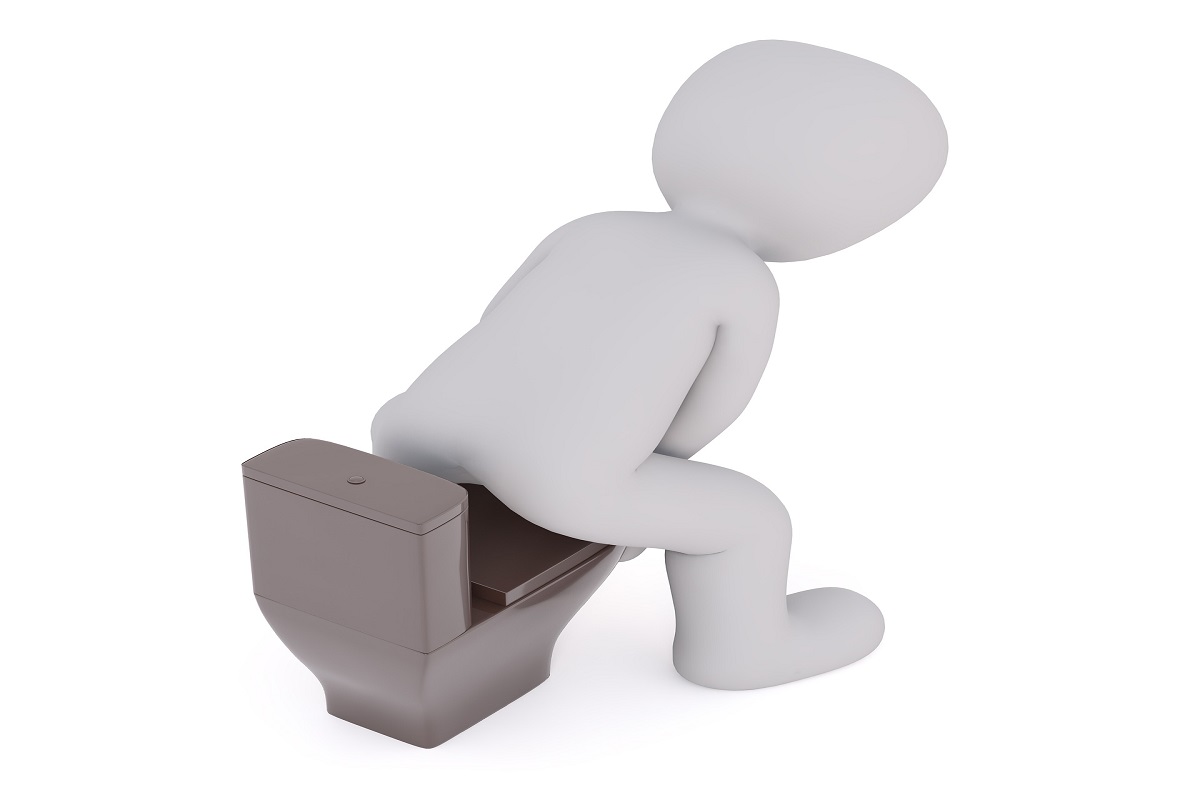
Sitting upright on a standard toilet keeps a muscular sling around the lower bowel partly engaged, which maintains a bend in the passage — useful for staying continent during the day, less useful when you are trying to empty. Bringing the knees above the hips relaxes that sling and straightens the route, so less effort is needed.

How to sit

  1. Place a low footstool, a step, or a stack of books in front of the toilet — roughly 15–20cm high.
  2. Sit with both feet flat on it so your knees sit clearly above your hips.
  3. Lean forwards from the hips and rest your forearms on your thighs. Keep your back long rather than hunched.
  4. Let your belly relax and bulge outwards. Most people pull the stomach in, which works against you.
  5. Breathe out slowly through the mouth rather than holding your breath and bearing down.
  6. Give it a few minutes without forcing. If nothing comes, stand up and return later.

Evidence note: the research here is small in scale, mostly measuring straining, sitting time and how complete emptying feels. That is modest evidence — but the change is free, carries no risk, and many people notice a difference the same day, which makes it a sensible first step rather than a last resort.

low wooden footstool positioned in front of a toilet · green kiwifruit halved on a plate beside a bowl of prunes · person lying on back drawing both knees towards the chest on a yoga mat

Food and drink, graded by evidence

Most guides list a dozen foods as though they were interchangeable. They are not. Here they are sorted by how much human evidence sits behind them, so you can spend your effort where it is most likely to pay off.

Strong evidence

Psyllium (ispaghula husk). A soluble fibre supplement, well studied and widely used. It bulks and softens stool. Start low and always take it with plenty of water. Bloating and wind are the usual complaints.

Prunes (dried plums). Repeatedly shown in trials to increase stool frequency and soften consistency, typically at around 100g a day. They combine fibre with sorbitol, a sugar alcohol that draws water into the bowel.

Kiwifruit. Two green kiwifruit a day has been tested in several trials, including head-to-head against prunes and psyllium, with comparable benefit and notably fewer side effects.

Moderate evidence

Dietary fibre generally. Fruit, vegetables, wholegrains, pulses. Effective over weeks rather than hours, and the increase has to be gradual — see the next section.

Fluid. Hydration on its own rarely fixes constipation in someone already well hydrated, but fibre without adequate fluid reliably makes things worse. Treat it as a requirement, not a remedy.

Physical activity. Regular movement supports normal transit. Helpful and worth doing; not a rescue plan for today.

Coffee. Stimulates bowel activity in many people within minutes. Bear in mind it is also mildly diuretic, so pair it with water rather than replacing water with it.

Early or mixed evidence

Probiotics. Some studies report improved stool frequency, but strains and doses vary so widely that results are hard to generalise. Speak to a doctor first if you are immunocompromised.

High-mineral (magnesium-rich) water. Tested in a handful of small trials with some benefit. Low risk for most people.

Flaxseed and other seeds. Plausible and commonly recommended; trial evidence is thinner than for psyllium.

Traditional use — take care

Senna tea. Genuinely a stimulant laxative, not a gentle herbal drink. Suitable for short-term use only, and it can cause cramping. It is not a daily wellness habit.

Castor oil. An old remedy with a strong stimulant effect and unpleasant cramping. Not recommended in pregnancy, and not something to reach for routinely.

Herbal blends containing senna or similar. Some can interact with prescribed medicines. Check with a pharmacist before combining anything with existing prescriptions.

How to increase fibre without making things worse

This is where most home attempts fail. Someone reads that fibre helps, doubles their intake overnight, and within two days feels bloated, gassy and more blocked than before. They conclude fibre does not work for them. In fact they changed too much, too fast, with too little fluid.

Three rules make the difference:

  • Increase gradually. Add roughly one extra portion every few days and let your gut adjust. Reaching a good intake over a month beats reaching it by Thursday.
  • Add fluid at the same time. Soluble fibre works by holding water. Without it, you have added bulk without softness — exactly the wrong result.
  • Use both types. Soluble fibre (oats, psyllium, apples, pulses) softens and gels; insoluble fibre (wholegrains, bran, vegetable skins) adds bulk and speeds transit. Most people who struggle have plenty of one and little of the other.

Editor’s insight: If fibre has made you feel worse in the past, you have useful information, not a verdict. Halve the amount, double the water, and add it over a fortnight instead of a weekend.

Abdominal massage, step by step

Abdominal massage is used in clinical settings for long-standing constipation. It follows the path of the large bowel, which travels up the right side of the abdomen, across beneath the ribs, and down the left.

  1. Timing. Roughly 30–60 minutes after a meal, when bowel activity naturally increases.
  2. Position. Lie on your back with knees bent and feet flat, or sit reclined. Let the abdomen soften.
  3. Start low right. Using flat fingers or a loose fist, make small circles just inside the right hip bone.
  4. Travel the route. Work slowly up the right side, across under the ribs, then down the left side to the left hip.
  5. Pressure. Firm but comfortable. This should never be painful.
  6. Duration. Five to ten minutes, breathing slowly throughout. Repeat daily rather than intensely.

Who should not do this: avoid abdominal massage in pregnancy, after recent abdominal surgery, with an abdominal hernia, active inflammatory bowel disease, undiagnosed abdominal pain, or any abdominal lump — and ask a healthcare professional first if you are unsure.

Gentle yoga and breathing for the bowel

Two things make yoga a sensible companion here. It provides gentle movement and mild abdominal compression without strain, and the slow breathing that accompanies it shifts the body towards the resting state in which digestion works best. Digestion is not a priority for a nervous system braced for a difficult day — and stress-related constipation is extremely common.

A short morning sequence, five to ten minutes, before your first drink of the day:

  • Knees to chest (apanasana). On your back, draw both knees towards the chest and hold gently for 5–8 slow breaths. Release and repeat twice.
  • Gentle supine twist. Knees bent and together, lower them slowly to one side, arms wide, head turning the other way. Hold for 6 breaths each side.
  • Wind-relieving pose (pawanmuktasana). One knee at a time to the chest, the other leg long, 5 breaths each side.
  • Supported squat (malasana). Feet apart, sitting bones towards the floor, heels supported by a folded blanket if they lift. Stay for 30–60 seconds, breathing into the belly.
  • Seated forward fold, unforced. Bend the knees generously and rest the chest towards the thighs for 6 breaths.

Then finish seated or lying with slow diaphragmatic breathing: one hand on the belly, breathe in for a count of four so the hand rises, out for six as it falls. Two or three minutes is plenty. The exhale is the part that matters — a longer out-breath is what encourages the shift towards rest.

Evidence note: research on yoga specifically for constipation is early — small studies, short follow-up, and often bundled with other lifestyle changes. Treat it as a well-tolerated support with a plausible mechanism, not a proven treatment. Safety: skip deep twists and strong abdominal compression in pregnancy, after recent abdominal surgery, with a hernia, or with any back condition your clinician has warned you about. Nothing here should hurt.

Medicines that commonly cause constipation

If your constipation started or worsened within a few weeks of a new prescription, the cause may be sitting in your medicine cabinet rather than on your plate. Medicines frequently associated with constipation include opioid painkillers such as codeine and morphine, iron tablets, some antidepressants, certain blood pressure medicines, antacids containing aluminium or calcium, and some medicines used for bladder or allergy symptoms.

Important: never stop or change a prescribed medicine because of constipation. Speak to your GP or pharmacist — there is often a different formulation, a dose adjustment, or a laxative routinely prescribed alongside it. Opioid-related constipation in particular usually needs a specific plan rather than more fibre.

Laxatives explained — and the dependency question

Type How it works Typical timing Notes
Bulk-forming Adds fibre bulk and holds water 2–3 days Must be taken with plenty of fluid
Osmotic Draws water into the bowel 2–3 days Commonly used for longer-term management
Stimulant Prompts the bowel muscles to contract 6–12 hours Faster, but cramping and loose stools are common
Stool softener Lets water mix into the stool Varies Often used where straining must be avoided

Are laxatives addictive? Short-term use of the right type, as directed, is a normal part of treating constipation and is not something to feel anxious about. The concern applies mainly to prolonged, unsupervised use of stimulant laxatives. If you find yourself needing a stimulant laxative regularly for more than a week or two, that is the signal to see a GP — not to keep going quietly, and not to stop everything abruptly.

Constipation in pregnancy and after birth

Constipation is common during pregnancy and in the weeks after giving birth, and the usual first steps still apply: fluid, gradual fibre, gentle movement and good toilet position.

What changes is caution. Avoid castor oil, avoid senna and other stimulant laxatives unless a midwife, GP or pharmacist has specifically advised them, and skip deep abdominal massage and strong twists. Iron supplements prescribed in pregnancy are a frequent contributor, so mention constipation at your next appointment rather than working around it alone.

When to see a GP: red flags

Book an appointment if:

  • Constipation has lasted more than three weeks despite diet and lifestyle changes
  • There is blood in your stool, or bleeding from the bottom
  • You are losing weight without trying
  • You feel unusually tired, or have been told you are anaemic
  • You have a persistent change in bowel habit, particularly if you are over 50
  • You have severe or persistent abdominal pain, or you are vomiting
  • You cannot pass wind at all, or the abdomen is swollen and painful — seek urgent advice
  • A baby, young child or an older person in your care is affected and simple measures are not helping

None of these means something serious is happening. They mean the question is no longer one a home remedy can answer. In the UK you can also speak to a pharmacist without an appointment, or call NHS 111 if you are unsure how urgent something is.

Real case study: kiwifruit, prunes or psyllium?

The study. Researchers at a US medical centre compared three natural treatments in adults with chronic constipation, published in the American Journal of Gastroenterology in 2021. Seventy-nine patients were partially randomised to two green kiwifruit a day, 100g of prunes a day, or 12g of psyllium a day for four weeks, with complete data for 75.

What it found. All three increased the number of complete spontaneous bowel movements. Stool consistency improved with kiwifruit and prunes, and straining improved with all three. The kiwifruit group also reported significantly less bloating, had the fewest side effects, and were the least likely to be dissatisfied with their treatment.

What it means for you. If you have tried fibre supplements and abandoned them because of bloating, kiwifruit is a reasonable next thing to try — same job, gentler ride.

Limitations, honestly. The study was small and exploratory, only partially randomised, had no placebo group, and the participants were predominantly female at a single centre. One analysis also noted that the kiwifruit benefit appeared to ease after the first fortnight. Encouraging, not conclusive.

Source: Chey SW, Chey WD, Jackson K, Eswaran S. Exploratory Comparative Effectiveness Trial of Green Kiwifruit, Psyllium, or Prunes in US Patients With Chronic Constipation. Am J Gastroenterol. 2021;116(6):1304–1312.

Common mistakes

1. Doubling fibre overnight

Why it happens: fibre is the headline advice everywhere. Why it matters: a sudden jump causes bloating and wind, and people give up on the one thing most likely to help. Better: add one portion every few days, with extra fluid.

2. Ignoring the urge

Why it happens: meetings, school runs, a toilet you would rather not use. Why it matters: repeatedly overriding the signal makes it quieter, and stool left longer becomes harder. Better: when the urge arrives, go.

3. Sitting and straining for twenty minutes

Why it happens: determination, plus a phone. Why it matters: straining risks haemorrhoids and fissures, and pain then makes the next attempt harder. Better: ten minutes maximum, no forcing, leave the phone outside.

4. Treating senna tea as a gentle daily habit

Why it happens: it is sold as a herbal wellness drink. Why it matters: it is a stimulant laxative, meant for short-term use. Better: use it briefly if at all, and ask a pharmacist what suits you for anything ongoing.

5. Never suspecting your medication

Why it happens: constipation is blamed on diet by default. Why it matters: no amount of prunes will outrun a medicine that slows the gut. Better: check the start date against your prescription history and raise it with your pharmacist.

Editor’s insights

  • Timing beats effort. The gut’s activity rises after eating and in the first hour after waking. A calm ten minutes after breakfast will do more than an hour of trying at random times.
  • Travel, not diet, breaks most routines. Different timings, less water, an unfamiliar bathroom. Pack a portion of prunes and keep breakfast time steady, and most holiday constipation never starts.
  • The pelvic floor can be the whole problem. If you strain hard and still cannot empty despite soft stool, muscles may be tightening when they should release. That is a treatable physiotherapy issue, not a fibre issue — worth mentioning to your GP.
  • Relaxing the belly feels wrong and is right. Most of us brace the stomach when we push. Letting it bulge outwards on a slow exhale is more effective and far kinder to the pelvic floor.

What to try first, by situation

Your situation Start with
Occasional, otherwise healthy Fluid, a walk, footstool, go after breakfast
Bloating whenever you add fibre Two kiwifruit daily instead of a supplement
Hard stool, lots of straining Fluid plus a softening approach; ask a pharmacist
Stress-related, worse in busy weeks Morning sequence and slow breathing; protect the post-breakfast window
Started after a new prescription Speak to your pharmacist or GP before changing anything else
Pregnant or recently given birth Fluid, gradual fibre, posture; ask your midwife before any laxative
Any red-flag symptom A GP appointment, not a remedy

A seven-day gut-friendly reset

  • Put a footstool in the bathroom today and use it every time.
  • Drink a glass of water on waking, before tea or coffee.
  • Eat breakfast, then keep ten unhurried minutes free afterwards.
  • Add one fibre portion every second day — not all at once.
  • Have two kiwifruit or a portion of prunes daily.
  • Walk for 20 minutes, ideally at the same time each day.
  • Do the five-minute morning sequence and two minutes of slow breathing.
  • Go when you feel the urge, and never strain.
  • Note what changes. If nothing has by day seven, speak to a pharmacist.

Health note: this article is general education, not medical advice, and it does not replace care from your GP, pharmacist, midwife or specialist. If you have a health condition, are pregnant, are recovering from surgery, or are taking medication, get professional advice before starting something new. Stop anything that causes pain.

Frequently asked questions

How can I relieve constipation immediately at home?

Drink a warm drink, walk for 15–20 minutes, then sit with a footstool so your knees are above your hips, leaning forwards and letting the belly relax. Try shortly after a meal, when bowel activity naturally rises. Do not strain — if nothing happens in ten minutes, get up and return later.

How long is too long without a bowel movement?

There is no single cut-off, because normal ranges from three times a day to three times a week. As a practical guide, if you have gone three days with no movement and no success with home measures, speak to a pharmacist, and see a GP if constipation persists beyond three weeks.

Does a footstool really work?

Raising the knees above the hips relaxes the muscle that maintains a bend in the lower bowel, making emptying easier. The studies are small and mostly measure straining and sitting time rather than long-term outcomes, so the evidence is modest — but it is free, risk-free and often noticeable immediately.

Are laxatives bad for you?

Used appropriately and for a short period, laxatives are a normal treatment. The concern is prolonged unsupervised use of stimulant types. If you need them regularly for more than a week or two, that is a reason to see a GP rather than to continue or to stop abruptly.

Can stress cause constipation?

Yes. The gut and nervous system are closely linked, and digestion is deprioritised when the body is in a stress state. Stress also disrupts routine, sleep and hydration. Slow breathing, gentle movement and protecting a predictable morning window all help, alongside the dietary basics.

Which yoga poses help with constipation?

Gentle options include knees-to-chest, a supine twist, wind-relieving pose, a supported squat and an easy seated fold, finished with slow belly breathing. Evidence is early rather than strong. Avoid deep twists and abdominal compression in pregnancy, after abdominal surgery or with a hernia.

Is coffee good or bad for constipation?

Coffee stimulates bowel activity in many people within minutes, so it can genuinely help. It is also mildly diuretic, so drink water alongside it rather than instead of it. If coffee worsens your reflux or anxiety, the trade-off may not be worth it.

Can medication be the cause?

Frequently. Opioid painkillers, iron tablets, some antidepressants, certain blood pressure medicines and some antacids are all associated with constipation. Never stop a prescribed medicine yourself — ask your GP or pharmacist, who can often adjust the formulation or add appropriate treatment.

When should I worry about constipation?

See a GP if it lasts more than three weeks, or sooner with bleeding, unexplained weight loss, persistent severe pain, vomiting, unusual tiredness, or a lasting change in bowel habit — particularly over the age of 50. Seek urgent advice if you cannot pass wind and your abdomen is swollen and painful.

Does drinking more water really help constipation?

Extra fluid helps fibre do its job by keeping stool soft enough to pass, but water alone rarely fixes constipation if fibre intake stays low. Aim for both together: enough fluid to feel like you rarely need to think about thirst, alongside a gradual increase in fibre-rich foods.

Can exercise really help with constipation?

Yes, moderate evidence supports it. Movement, especially walking, stimulates the muscle contractions that move stool through the colon. A short walk after meals is a low-effort way to add this without a structured workout routine.

Where to start tomorrow

If you take one thing from this guide, make it the boring one: a footstool, a glass of water before your first cup of tea, and ten unhurried minutes after breakfast. Add kiwifruit or prunes, build fibre slowly, and give it a week before judging.

And keep the red flags in view. Most constipation is a plumbing problem you can solve at home. The small number of times it is something else, the sooner you ask, the better.

About the author

Written and reviewed by the Spiritual Meditation Yoga Editorial Team. Spiritual Meditation Yoga publishes educational content covering meditation, yoga, mindfulness, spirituality and holistic wellbeing. Our editorial approach prioritises clear explanations, responsible wellness guidance, appropriate source checking, and a transparent distinction between traditional teachings and evidence-based information.

Last reviewed: September 2026

Sources and references

Title: The Origin of Yoga: A Clear, Honest History

Title: The Origin of Yoga: A Clear, Honest History

The Origin of Yoga: Where It Really Began, and How It Became What We Practise Today

Unroll a mat in a leisure-centre studio on a wet Tuesday evening and someone will almost certainly tell you that you are doing something five thousand years old. It is a lovely thought. It is also only partly true, and the part that is true is stranger and more interesting than the slogan. The origin of yoga does lie in ancient India — but the thing that began there was not a fitness class. It was a set of ideas about the mind, written down by people who sat still for a living.

The confusion is understandable. Yoga has been reinvented so many times, by so many different communities, that almost every popular claim about its history is half right. This guide separates what the evidence supports from what has simply been repeated often enough to sound like fact. You will find out where the word came from, who the key figures actually were, why “who invented yoga” has no single answer, and why the flowing sequence you practise on a Tuesday is probably younger than your grandmother.

Quick answer: where did yoga originate?

Yoga originated in ancient India. The word first appears in the Rig Veda, composed roughly between 1500 and 1200 BCE, but yoga as a system of practice took shape later — in the early Upanishads and then in Patanjali’s Yoga Sutras. The physical postures most people practise today are largely a modern development of the past 150 years.

Why trust this guide

  • It draws on academic history — including the Sanskrit scholarship of James Mallinson and Mark Singleton — rather than recycled blog summaries.
  • Where historians disagree, we say so plainly instead of picking the most flattering version.
  • Traditional teaching, modern interpretation and documented evidence are kept clearly apart throughout.
  • No teachers, lineages or credentials are invented, and no spiritual claim is dressed up as a scientific one.
  • Written and reviewed by the Spiritual Meditation Yoga Editorial Team. Last reviewed: September 2026.

Key takeaways

  • Yoga began in the Indian subcontinent, and its earliest written trace is the word itself in the Rig Veda.
  • No single person invented yoga. It was built up over centuries by many communities.
  • In classical yoga, asana meant a steady seated position for meditation — not a sequence of standing poses.
  • The popular claim that Indus Valley seals show yoga postures is disputed by specialists.
  • Yoga grew from Vedic soil but is not owned by one religion: Buddhist and Jain traditions developed their own yogas.
  • Modern posture yoga was shaped in the twentieth century, partly by Indian physical culture and European gymnastics.
  • Knowing the history makes practice richer, not smaller — and helps you practise respectfully.

Table of contents

  1. What the word “yoga” actually means
  2. Where did yoga originate?
  3. Who invented yoga?
  4. The timeline of yoga, period by period
  5. The Indus Valley claim: what the evidence shows
  6. Is yoga Hindu?
  7. How ancient yoga became modern posture yoga
  8. How yoga reached Britain
  9. Practising with respect
  10. Common misconceptions about yoga’s history
  11. Editor’s insights
  12. Classical yoga vs a modern class
  13. Reading the tradition for yourself
  14. Frequently asked questions
  15. About the author

What the word “yoga” actually means

Yoga comes from the Sanskrit root yuj, meaning to yoke or join. In the oldest Vedic texts it is used in a very physical sense: harnessing animals to a chariot, hitching one thing firmly to another. Only later does the word get turned inward, so that the thing being harnessed is attention, and the thing it is harnessed to is a chosen object — a breath, a sound, an idea, or, in the spiritual reading, the deepest layer of the self.

That shift from chariot to mind is the whole story in miniature. It tells you that yoga was never originally about flexibility. It was about discipline of attention, using whatever tools were available — sitting, breathing, chanting, ethical restraint, study — and the word kept its older flavour of effort and harness long after the chariots were gone.

This matters practically. If you have ever felt that you are “not flexible enough for yoga”, you are measuring yourself against a definition that nobody in the tradition would recognise. By the original meaning, a person who sits for ten minutes and keeps returning their attention to the breath is doing yoga more precisely than a person who can fold in half while thinking about work.

Where did yoga originate?

Yoga originated in the Indian subcontinent, in the northern regions associated with Vedic culture. The earliest surviving written appearance of the word is in the Rig Veda, a collection of hymns composed in an archaic form of Sanskrit and preserved for generations by memorised oral recitation before it was ever written down. Scholars generally place its composition between roughly 1500 and 1200 BCE.

But a word is not a practice. What we would recognise as yoga — a deliberate method for stilling and directing the mind, with a goal of liberation — appears more clearly in the early Upanishads, philosophical texts composed in the centuries after the Vedas. The Katha Upanishad, for example, describes the steady holding of the senses as yoga, using the same chariot imagery the word had carried all along.

So there are really three separate “origins”, and most arguments online come from mixing them up: the origin of the word (Vedic, roughly 3,200–3,500 years ago), the origin of the practice as a systematic path (Upanishadic and later, roughly 2,500 years ago), and the origin of the posture practice most Britons do today (largely the twentieth century). All three statements are true. They are just answers to different questions.

Editor’s insight: When a teacher, a book or a website gives you a single confident number for yoga’s age, check which of those three things they are actually dating. Nine times out of ten the number belongs to the word and is being quietly applied to the postures.

Who invented yoga?

No one person invented yoga. It has no founder in the way that a religion or a company has a founder. Yoga developed over more than two thousand years across several traditions, each borrowing from the others, and the texts we have were often compilations of teachings already in circulation. Asking who invented yoga is a bit like asking who invented cooking.

That said, a handful of figures genuinely changed its direction:

  • The anonymous Upanishadic sages — turned ritual outward-facing practice into inward enquiry.
  • Patanjali — compiled the Yoga Sutras, the terse aphorisms that gave classical yoga its eight-limbed structure. He is better understood as an editor of an existing tradition than as an inventor.
  • Vyasa — the commentary attributed to him made the Sutras usable; without a commentary, the aphorisms are close to unreadable.
  • The hatha yogis — medieval ascetics who developed physical and breath-based techniques, recorded in texts such as the Hatha Yoga Pradipika.
  • Tirumalai Krishnamacharya — the twentieth-century teacher whose students carried posture-based yoga to the rest of the world.

Notice how thin the biographical detail is for the earlier names. Even Patanjali’s dates are contested, with scholars proposing anything from the second century BCE to the fifth century CE, and some arguing the Sutras and the commentary may have circulated as one work. Anyone who gives you a confident birth date is filling in a gap the sources leave open.

The timeline of yoga, period by period

Historians usually divide yoga’s development into broad periods. The dates overlap and the boundaries are arguments rather than facts, but the sequence is sound — and it shows how late the physical side arrived.

1. Vedic period — roughly 1500–500 BCE

Ritual, fire ceremony, chanted hymn. The word yoga appears, mostly meaning yoking or harnessing. There is no posture practice here, and no systematic method. What exists is the idea that disciplined attention and sound can reach beyond ordinary experience.

2. Pre-classical period — roughly 800–200 BCE

The Upanishads turn the enquiry inward: the senses are restrained, attention is gathered, liberation becomes the aim. The Bhagavad Gita, part of the Mahabharata, later sets out several routes — knowledge, devotion and action — establishing the idea that there is more than one valid yoga.

3. Classical period — Patanjali’s Yoga Sutras

Yoga is organised into eight limbs: ethical restraints, personal observances, posture, breath regulation, withdrawal of the senses, concentration, meditation and absorption. Posture gets exactly three aphorisms, and the instruction is essentially that the seat should be steady and comfortable. That is the whole asana syllabus of classical yoga.

4. Post-classical period — tantra and hatha yoga

From around the eleventh century, ascetic and tantric communities develop techniques that work directly with the body and breath: seals and locks, breath retention, cleansing practices, and a growing repertoire of postures. The Hatha Yoga Pradipika, compiled in the fifteenth century, is the best known of these manuals. This is where physical yoga genuinely begins — and its aims were still spiritual, not athletic.

5. Modern period — 1890s to now

Indian teachers begin presenting yoga to international audiences, physical culture and gymnastics leave their mark, and posture moves from the margins to the centre. Within a century, “yoga” in most of the world comes to mean a class of standing and seated poses, taught in a room with mats.

The Indus Valley claim: what the evidence shows

You will read almost everywhere that yoga is 5,000 years old because seals from the Indus Valley civilisation show figures sitting in yogic postures. The best known is a seal from Mohenjo-daro depicting a seated horned figure, named by its early excavator as a proto-Shiva in a meditative pose.

It is a seductive piece of evidence and a shaky one. The Indus script has never been deciphered, so we cannot read what the seal says about itself. Specialists have argued for decades over whether the figure is a deity, a ruler, an animal-master motif or something else entirely, and whether a cross-legged seated position on a small carved stamp can be called yoga at all — people across the ancient world sat cross-legged because there were no chairs.

Frame What it holds
Traditional perspective Yoga is beginningless, revealed rather than invented, passed from teacher to student since time out of mind.
Modern interpretation The seals are read as proof of a continuous 5,000-year posture lineage running unbroken to today’s classes.
What the evidence supports Seated figures exist on Indus artefacts. The word yoga is attested from the Rig Veda. Systematic yoga is documented from the Upanishads onward.
Evidence limitation The script is undeciphered, the images are ambiguous, and there is no textual bridge linking Indus imagery to later yogic teaching. The connection remains an interpretation, not a finding.

None of this diminishes yoga. A documented 2,500-year intellectual tradition is an extraordinary inheritance. It simply does not need a round number attached to it.

Is yoga Hindu?

Yoga grew from the same Vedic and Indian philosophical soil as Hinduism, but it is not the exclusive property of one religion. Buddhist traditions developed their own extensive yogic and meditative systems; Jain practice includes its own disciplines of restraint and stillness; and in the medieval period, hatha techniques travelled between ascetic communities of different affiliations rather than staying inside one.

The Buddha’s own story illustrates the point: before his awakening he is described as seeking out the meditation teachers available in his time and training in the yogic methods of the day, before concluding that severe asceticism was not the answer. Whatever you make of the account theologically, it describes a shared landscape of practice, not a single-owner one.

In practical terms: you can practise yoga without adopting any religion, and many people do. What is not accurate is to claim yoga has no religious roots at all. It has deep ones. The honest position is to acknowledge the roots and then be clear about what you personally are doing with the practice — which is, in the end, a more respectful stance than pretending the history is neutral.

How ancient yoga became modern posture yoga

This is the part of the story most classes skip, and it is the part that answers the question you actually came with.

In the late nineteenth century, Indian teachers began presenting yoga to Western audiences — most famously when Swami Vivekananda addressed the World’s Parliament of Religions in Chicago in 1893 and went on to publish an influential book on raja yoga. What he presented was overwhelmingly philosophical and meditative. Postures barely featured.

The posture revolution came later, and it came from a specific place. Working at the Mysore Palace in the 1930s, Tirumalai Krishnamacharya developed a vigorous, flowing, posture-centred method for teaching young students. Historians of modern yoga — Mark Singleton’s research is the standard reference — have traced how that method drew not only on hatha texts but also on the Indian physical-culture movement and the European gymnastics and bodybuilding systems then circulating in India, including through the colonial school curriculum.

Krishnamacharya’s students then carried versions of it worldwide: B.K.S. Iyengar with his precision and props, K. Pattabhi Jois with the set Ashtanga sequences, Indra Devi teaching in Hollywood, and T.K.V. Desikachar with an adaptive, individual approach. Nearly every mainstream posture style practised in Britain today traces back through one of those four.

Editor’s insight: The sun salutation is the clearest example. It is treated as timeless, yet it does not appear as a sequence in the classical or medieval yoga literature in the form we practise it. Something being recent does not make it worthless — it makes it honest to call it modern.

How yoga reached Britain

Indian philosophical ideas circulated in Britain long before anyone taught a posture class here, arriving through colonial-era translation, scholarly societies and the Theosophical movement of the late nineteenth century. For decades, yoga in Britain meant reading about Vedanta, not standing on a mat.

That changed after the Second World War. Iyengar’s teaching visits and his 1966 book Light on Yoga gave British students a systematic posture method; adult education institutes began running evening classes; and the British Wheel of Yoga was founded in 1965, eventually becoming the recognised national governing body for the practice in this country. Television and local authority classes did the rest.

The result is the landscape you know: yoga in leisure centres, church halls, gyms and studios, taught by teachers whose certificates trace back through a handful of twentieth-century Indian lineages, to students who often have no idea any of this happened. Which is a shame, because the story is far more interesting than the slogan on the studio wall.

seated meditation posture on a plain mat, side view · timeline graphic showing the five historical periods of yoga · open Sanskrit text with English translation beside it

Practising with respect

Because yoga as exercise spread through the Western world using Sanskrit names and symbols such as Om, it has been described by some commentators as cultural appropriation. Others — including scholars of the subject — point out that yoga has changed continuously in both India and the West, that Indian practitioners have themselves adopted Western innovations, and that the charge is harder to sustain than it first appears. Both positions are held seriously, and this guide does not pretend the argument is settled.

What you can do is straightforward, and none of it requires taking a side in that debate:

  • Learn a little of the history — which you have now done.
  • Use Sanskrit terms accurately, or use English. Half-remembered Sanskrit as decoration serves nobody.
  • Treat sacred imagery as sacred rather than as studio styling.
  • Be honest about what your class is. A strong, sweaty posture session is a fine thing; it is not automatically a 5,000-year-old spiritual practice.
  • Read at least one thing written by someone from within the tradition, not only about it.

Common misconceptions about yoga’s history

1. “Yoga is 5,000 years old, so my class is too.”

Why it spreads: the number is memorable and flattering. Why it matters: it collapses three different histories into one and makes people suspicious of yoga history generally once they discover the gap. Better: the tradition is ancient; your posture sequence is modern. Both can be true.

2. “Patanjali invented yoga.”

Why it spreads: the Yoga Sutras are the most quotable source. Why it matters: it erases the centuries of practice the Sutras were summarising. Better: Patanjali organised and compiled an existing body of teaching — enormously important, but not the beginning.

3. “Ancient yogis practised the poses we practise.”

Why it spreads: Sanskrit pose names sound old, and many are. Why it matters: it can make students feel they are failing at something eternal when they struggle with a recent invention. Better: classical asana meant a stable seat; the standing repertoire expanded mainly in the medieval and modern periods.

4. “Yoga has nothing to do with religion.”

Why it spreads: it makes yoga easier to sell in secular settings. Why it matters: it misrepresents the sources and can feel dismissive to communities the practice came from. Better: the roots are religious and philosophical; your engagement with them is your own choice.

5. “There is one authentic original yoga.”

Why it spreads: lineages compete, and “original” is persuasive marketing. Why it matters: it turns a plural tradition into a purity contest. Better: there were always several yogas running side by side — of knowledge, devotion, action, breath and body.

Editor’s insights

  • The oral tradition explains the vagueness. These teachings were memorised and recited for centuries before being written. Dates are fuzzy not because the tradition is weak, but because writing was a late arrival to it.
  • Terse texts need commentaries. The Yoga Sutras are deliberately compressed, written to be memorised and then unpacked by a teacher. Reading them alone and finding them cryptic is not a failure of understanding — it is the intended design.
  • Every generation reinvents yoga, including the ones we call traditional. The hatha yogis were radicals in their day. Treating any one period as the frozen “real” yoga misreads how the tradition has always worked.
  • Knowing the history changes how you practise, quietly. Once you know asana originally meant a steady seat, the last five minutes of class stop feeling like an add-on and start feeling like the oldest thing in the room.

Classical yoga vs a modern class

Element Classical yoga A typical modern class
Main aim Stilling the mind; liberation Strength, mobility, stress relief, wellbeing
Role of posture A steady seat for meditation The central activity of the session
Ethics First two limbs; the foundation Usually mentioned briefly, if at all
Setting Solitary or one-to-one with a teacher Group class, fixed hour, music optional
Breath work A distinct limb with its own discipline Cueing alongside movement; occasional pranayama
Measure of progress Steadiness of attention Flexibility, strength, how you feel afterwards

Neither column is the “correct” yoga. The table is there so you can see what your practice currently emphasises — and what is available to you if you ever want to widen it.

Reading the tradition for yourself

  • Choose a translation with a scholarly introduction and notes, not just the verses.
  • Check whether the translator explains their choices — good ones flag where a Sanskrit word has no clean English equivalent.
  • Read at least one academic history alongside the primary text, so you can see the context it came from.
  • Be wary of editions that promise the “secret” or “original” meaning; the tradition has been public for centuries.
  • Start with the Yoga Sutras or the Bhagavad Gita, then move to a history of hatha yoga — that order makes the medieval material far easier to place.
  • Give yourself permission to read slowly. These texts were written to be returned to, not finished.

Frequently asked questions

Where exactly did yoga originate?

In the Indian subcontinent, in the northern regions associated with Vedic culture. The earliest written trace of the word is in the Rig Veda, and the earliest descriptions of yoga as a method of stilling the mind appear in the early Upanishads that followed.

How old is yoga, really?

The word is roughly 3,200–3,500 years old. Yoga as a documented system of practice is around 2,500 years old. The posture-based class most people attend today largely took shape in the twentieth century. The popular figure of 5,000 years relies on contested interpretations of Indus Valley artefacts.

Who is the father of yoga?

Patanjali is often given that title for compiling the Yoga Sutras, and Krishnamacharya is sometimes called the father of modern yoga. Both descriptions are shorthand. Yoga has no single founder, and the earliest contributors are anonymous.

Is yoga a religion?

Yoga is a practice rather than a religion, but it developed within religious and philosophical traditions and its classical texts assume a spiritual goal. Many people practise it secularly. That is a legitimate choice, as long as the roots are acknowledged rather than erased.

Did yoga come from Hinduism or Buddhism?

Its foundations are Vedic, the same wellspring from which Hinduism developed. Buddhist and Jain traditions then developed their own yogic and meditative systems, and techniques moved between these communities for centuries. It is shared heritage, not a single lineage.

Is modern yoga authentic?

If authentic means identical to ancient practice, no form of yoga taught anywhere today qualifies — including in India. Traditions live by adapting. Modern posture yoga is a genuine development within a long tradition, and it is most honest when it does not claim to be something older than it is.

When did yoga arrive in Britain?

Yogic philosophy circulated here from the nineteenth century through translation and societies interested in Indian thought. Posture teaching spread widely from the 1950s and 1960s, helped by Iyengar’s teaching and writing, adult education classes and the founding of the British Wheel of Yoga in 1965.

Do I need to know the history to practise?

No. You can benefit from yoga knowing none of this. But understanding where it came from tends to change the practice quietly — it lowers the pressure to perform, and it makes the stiller parts of a class feel like the point rather than the cool-down.

Where this leaves you

The origin of yoga is not a single date. It is a long, uneven, genuinely remarkable process: a word for harnessing animals became a word for harnessing attention; a philosophy of liberation grew a body of physical technique; and a twentieth-century teaching method carried the whole thing around the world in a form its earliest authors would barely recognise — and might well find interesting.

If you want one practical next step, make it this: at the end of your next session, when you finally sit still, notice that you have arrived at the oldest part of the practice. Everything before it was the preparation.

About the author

Written and reviewed by the Spiritual Meditation Yoga Editorial Team. Spiritual Meditation Yoga publishes educational content covering meditation, yoga, mindfulness, spirituality and holistic wellbeing. Our editorial approach prioritises clear explanations, responsible wellness guidance, appropriate source checking, and a transparent distinction between traditional teachings and evidence-based information.

Last reviewed: September 2026

Sources and further reading

  • Mallinson, J. & Singleton, M. (eds), Roots of Yoga, Penguin Classics, 2017.
  • Singleton, M., Yoga Body: The Origins of Modern Posture Practice, Oxford University Press, 2010.
  • Bryant, E. F., The Yoga Sutras of Patanjali, North Point Press, 2009.
  • White, D. G. (ed), Yoga in Practice, Princeton University Press, 2012.
  • Flood, G., An Introduction to Hinduism, Cambridge University Press, 1996.
  • Rubin Museum of Himalayan Art, The Origins of Yoga.
  • Google Arts & Culture, Explore the Ancient Roots of Yoga.